I'm so glad that this is getting more visibility. I spent 5 long years at Amazon Web Services from 2008 - 2013 as a Software Development Engineer, and was at some point promoted to SDE II ;)
It's a shark eat shark environment. I never cried, but I saw others (specially female colleagues) do. After 2 years of waking up in the middle of the night for bullshit on-call pages (wack-a-mole with production issues) and increasingly heavier deadlines, I developed stress related medical issues. That was a wake up call for me, and as soon as I realized the shit place that I was in, I started showing up at the office detached, practicing interview questions and doing phone screen interviews from work. I eventually got offers from Facebook/Google, and moved on. It was only then that I realize I was actually paid at the 50th percentile for my position's level and experience all along.
Since I left, I've helped multiple other friends/colleagues detach emotionally from the need for approval, practice for interviews and get job offers from Apple/FB/Google for substantial (> %75) raises.
I get Amazon recruiters contacting me all the time, and I'm always nice to them because I know the shit environment they're stuck in. Though in the back of my mind I'm thinking "there's no way in hell I'd ever go back"
Fuck Jeff, fuck Amazon, fuck AWS, and fuck their leadership principles.
I heard few stories from friends/colleagues who worked there
- There was a production outage once at Amazon and my friend's manager and her team (including my friend) gave a post-mortem to a large audience. Port-mortem sessions are open for everyone to attend. He mentioned, it was a free-for-all. Execs were hurling F-bombs every sentence and the team was publicly humiliated. The manager was in tears and was later demoted. I could see how my friend was feeling for her as a person/human being.
- One employee asked about possibility of providing free food ala Google/FB in a org level all-hands. Exec pooh-poohed Google for being highly irresponsible and that they can never sustain themselves spending so much on free food. Lazlo Block says it is one of the best things at Google.
- Frugality - I heard you don't even free get pop at Amazon. No paternity leave. Maternity leaves are much shorter compared to what people take at Google/Facebook out of fear. Poor health benefits and 401K matching compared to Microsoft/Google/FB.
- Sweatshop - People are over worked and are working on weekends/holidays a good chunk of time. 70 hr weeks seem to be the norm. Get only one day-off for Christmas and Thanksgiving.
Many Amazon execs are probably laughing their asses off looking at companies in the valley one-upping each other with great pay, quality free food, extending maternity/paternity leaves, generous health benefits and 401K contributions. "Look at these losers in the valley, and look at us, we pay employees pea-nuts, treat them like garbage, don't give a fuck about their well-being or families but still get a ton of shit done. Our stock is soaring! "
A good chunk of their engineers who are willing to take this kind of abuse are H1-Bs waiting for greencards. All new college grads wisen up after looking at their friends from Google/Facebook/Mircosoft, jump ship after a couple of years. Only people who stay there for a long time seem to be people who really like this kind of confrontational/psychopathic environment or incompetent engineers who rose into management, and cling onto their jobs.
"For a 25-30 year time frame AMZN will beat S&P and Walmart by several X. AMZN, GOOG are companies which will have a huge impact on how we live. I have put some money into them. They are Berkshire Hathaways of our time."
So you seem fine with whatever (exaggerated and imaginary) evil things the execs are up to, as long as you profit from that as well.
Thanks for bringing this up. I want Amazon to take better care of employees precisely because I have money invested in them; because I believe in a knowledge economy, the greatest asset a company has is its people, and in the long-term this will matter. Amazon can be a lot more valuable, if employees can build long-term careers there and are better cared for.
I am rational. I want my money to work hard for my family. If I believe, I can provide a secure future for my family by investing in AMZN then I will do that. Through all the mutual/index funds, I am probably invested in a lot of companies whose practices I disagree with. Examples: Avoiding taxes (double irish with a dutch sandwich), super low minimum wages and expecting public to pay for their care (walmart and food stamps use of their employees), abysmal working conditions (foxconn deaths/suicides), shipping manufacturing jobs to China/Malaysia/Philippines and exploiting low-wage workers there, advertising and selling unhealthy/processed and getting kids hooked to high-{sugar,salt,bad fat} diet. We have practically proved that the best engine to create wealth is capitalism. The dichotomy you have provided is a false one. I love all the good properties of capitalism but I am also aware of its acute shortcomings, if there is no government or regulation. This doesn't mean that I will stop being a rational economic actor.
Things I mentioned are what I heard from current/ex Amazon employees. What I wrote about benefits are facts (else people would have refuted them right away). Only exaggeration was about Execs laughing their asses off; I was just making a point.
This seems like a common misconception. Amazon's PE (and earnings in general) are terrible because they don't care about earnings at this point in their life; they are growing far too quickly in far too big a market to stop to take earnings. Slides 45-47 from this A16Z presentation illustrate this pretty well: http://www.slideshare.net/a16z/mew-a16z
Also, your assertion that Amazon is 'not really growing' doesn't really make sense or fit with any publicly-available data I can think of.
Considering the expectations implied by Amazon's stock price, are you sure it's a common misconception? Surely if the misconception was common, the valuation metrics would be much lower?
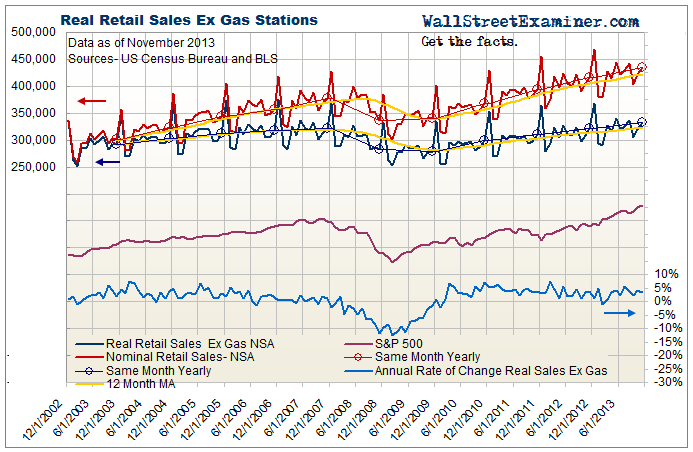
Amazon will never have the same impact on our lives like Walmart did. Simply because retail won't grow as much anymore as it did when walmart became big. We're moving into a digital economy (ironically to a small extent thanks to amazon and their elastic cloud) and there simply isn't as much revenue in a digital economy as there was in the traditional (physical) consumer goods economy. people earn less nowadays and consume less. walmart rode the heydays of consumerism in the US and I doubt retail spending will ever return to those heights: http://wallstreetexaminer.com/wp-content/gallery/economic-ch... amazon seems to me like the emerging, dominant player in a shrinking market. furthermore - looking at the digital consumer goods market - we see that in this market amazon is again playing second fiddle. this market is dominated by Google and Apple (which have much better offerings with respect to apps, music, etc.) and maybe EA and Valve for games (origin and steam respectively).
All companies are 'evil' in that they extract value for themselves at the expense of others. Amazon is probably less evil than Walmart though, since they are doing much more to reduce labor costs to distribute goods. Not that Walmart is necessarily evil either. Usually entirely a matter of perspective since large businesses have a huge effect on the ecosystem and have internal ecosystems there will always be many that see them positively and negatively.
>So you seem fine with whatever (exaggerated and imaginary) evil things the execs are up to, as long as you profit from that as well.
As long as the evil is easy to ignore and the profit large enough, I would dare say this is common among most people. Especially if you don't have to admit it (and thus take the hit to social reputation).
When you try to transfer, your boss puts in a report to HR about how you're such a bad employee (clearly the bosses are incentivized to do this, to keep employees from internally transferring.)
Once that happens you're on the clock- you're going to get fired, and they are just building a case against you.
Your boss and HR will become increasingly hostile (while HR pretends to be there to "help" and "mediate" but actually is working against you filling your file with bullshit that comes from your boss)
HR will start actively gas lighting you. The negative reports that are suddenly appearing in your file (eg: a previous boss who gave you a good review suddenly has criticized you in the file that only HR can see... why would he lie to you?)
They want you to think you're at fault for anting to work for a non-abusive boss.
Eventually they fire you and give you a meager severance check which is attached to a contract you sign where you promise to never sue them.
I think it's only a matter of time.
But it is a hostile work environment, my rights were violated regularly, and as far as I'm concerned, the company should be shut down.
No engineer with self esteem should work there. But people seem to think that it's glamerous because of the name and they don't know that it is better elsewhere.
I think their hiring process is tuned to find people who will fall for their mantras.
The culture is VERY cult like. Much more than Microsoft or Apple in this regard.
This is absolutely right and I have first hand experience with this.
I came back from my country after a 3 week vacation and during my 1:1 with my manager, she started criticizing things which she hardly ever mentioned. And then, a few weeks later, she and her manager pulled me aside and put me in a program where I would have to do much more difficult work (PIP) to save my job.
The PIP document was this scandalous piece of paper. Things which were a complete non-issue a few months back were made a huge deal. I had a seizure attack a few months before all this and my manager was well aware of my mental situation. Inspite of all this, she instrumented all this. I wouldn't blame here. She did this to save her own ass I guess. You've got to eat someone else's career to move yours ahead.
Bottom line is I wasn't able to cope up with the PIP work. I was made to resign and being an H-1B worker, I had to find a job to save my status. My health issues made me spiral into a depression and today I'm in a substandard job.
Sorry to hear about your experiences there. But I think it's good that you've realized that it wasn't your fault and you have a good perspective on the whole experience.
"Hostile Work Environment" != Miserable working conditions.
From blm.gov,
"A hostile work environment is
actionable in the EEO process when it
is based on allegations of discrimination;
e.g., race, color, sex, national origin,
religion, age, disability or sexual
orientation1, or reprisal."
I'm curious about one thing: what exactly was the source of your work-related stress, apart form the on-call pages? This is something people rarely elaborate on and I think is very important to get a good picture of the place.
I see two different sources of stress in engineering work: large volume stress and "hostile dev environment" stress (sorry, I wish I could come up with a better term). The first means just that you have a large load of things to do. Personally I am not that much bothered by it if my environment allows me to execute on that volume of tasks. What often has me going into mad rages is the second type of stress: IDE slowness, random unexplicable build crashes, inefficient engineering systems, poorly designed code that makes it really hard to test it quickly. You get the idea. You have a task to get done and you could get it done if it depended on your competence alone, but the development environment is so fucked up that you constantly battle it when trying to make the smallest of changes. That builds up a ridiculous amount of stress because now you feel like you're lagging behind, and it's not because you don't know how to do something, but simply because the very thing that should enable your work prevents you from doing so.
What of those kinds of stresses did you have at Amazon? I'm genuinely curious.
I'm not the OP but I've worked at Amazon for four years as an SDET. I think "hostile dev work environment" is a good description of working here but it's different from what you describe. What you describe is more like just dealing with a culture of pervasive incompetence.
Just a couple of examples. There is an immense amount of pressure to perform and deliver results. A lot of the time I don't even know what we are supposed to be delivering but I can tell there's a lot riding on delivering it. I've seen multiple managers demoted to individual contributor roles for, well I'm not sure what for. Presumably not delivering.
As for my own personal experience, there is the expectation that you as a developer will perform the work of several developers. I am expected to keep up with sometimes a thousand email messages a day, many of which require some action on my part, work on JIRA tickets assigned to me, attend meetings, answer questions from coworkers and fix bugs. But that is not nearly enough. One needs to "deliver results". So on top of the full time job described above, it is expected that I will conceive, plan, organize, and implement new features and new projects that deliver value. And I have to organize meetings so everyone knows about the new project and is aware of the value our team is delivering.
And yes, as you described, we also have to deal with figuring out how to get things done in spite of the incompetence of other teams we are working with.
Not the OP, but I worked at amazon for a year. I didn't want to pay back the signing bonus and relocation fees, or I would have quit earlier. Seattle has tons of way better opportunities for software developers.
Honestly, the stress originates from both. There was a lot of pressure to work ridiculous hours during the week and come in during the weekends (wtf??)
On top of that, the tools sucked. They give you a shitty laptop (frugality) that would go to the "locked" screen after x minutes if you were idle, and logging in could take 10 minutes because it was attached to an AD network and sometimes decided to use the server in China for authentication (seriously?)
If your keyboard broke or something of the sort you had to wait in line for hours to get another (crappy) working one.
They force you to use homegrown tools and plugins that are crashy and frustrating. I was soo tempted to just spend all the time fixing the tools, but I'm sure that would have gotten me into trouble, though it would have probably improved every software engineer's productivity.
This was a few years ago. Maybe someone has fixed all this by now :)
I think you can specify the VPN server. I do it all the time and never let it auto-pick.
Keyboard and other minor equipment acquiring process is also fixed/streamlined now. Its much more self-service and does not require standing in queue or getting manager approval.
And on top of all, the one thing I really respect/revere at Amazon are the builder tools. They are probably the best I've seen so far! And yeah, this is probably today and I've heard it was bad a few years back.
But I can relate to working on weekends though. That still remains.
When you can choose the tools you want to work with and still complain about them, then yes, you are at fault. But when you are forced to use a set of really bad tools and there's not much you can do about it, it's legit to complain about them.
It's one thing being able to choose to use e.g. Emacs, git, and a language of your choice vs. working on a project that requires you to use an outdated version control system, a clunky IDE and more of that sort.
What on earth are you even talking about? Most people at Amazon I know use IntelliJ or vim, its their choice. The languages teams use are also that teams choice. The whole company uses git. I don't think you ever worked there...
My wife works there as an SDET and her experience so far is vastly different from yours and from what the article says. Most days it's a 9-5 job. The only times she has stayed late were because she really wanted to finish something that day i.e. she was never told to do that. Maybe there's less pressure on SDETs? But she says the devs seem to work about as much, at least from her perspective.
Can definitely see how different parts of the company operate differently but no paternity leave an minimal maternity leave speaks a lot to the general philosophy of the overall company.
It's interesting - all (I think?) the people interviewed in the article sounded like they worked in non-dev roles. Might not be the case, but it might explain why your wife hasn't had the same experience.
I think the article is really exaggerating on negative points. Get a handful of people who had really bad managers and extrapolate their stories to the rest of the company - I'm pretty sure one can do that for any large company.
A co-worker's wife also works there as an SDET and her experience is the same as my wife's. A guy I went to college with works there as an SDE and he also says it's pretty much a 9-5 job. He doesn't work on a service though, so his team doesn't have pager duty and that contributes a lot to it not being a stressful job.
My wife worked there in a non-tech role and from the stories she and her friends told me I have to say that the article just scratches the top of the iceberg.
I think this is a very important point. While I have heard of very stressful orgs where SDEs are under high pressure, I think that the work environment for non Deve is vastly different.
Amazon treats SDETs much nicer in my experience. I can't really say why or how that is, but that's my experience. They seem to be shielded from the bulk of company politics, and don't seem to be common targets for throwing other people under the bus.
My job is 10-7, only because I take an hour off playing ping pong every day. My major complaint is that they don't have enough ping pong tables. Also, having to decide which food truck to eat at on a particular day is annoying. I'd much rather have free cafeteria food.
  7) Thank you; have a nice day!

  Ha, ha! You 150-odd ex-Amazon folks here will of course
  realize immediately that #7 was a little joke I threw in,
  because Bezos most definitely does not give a shit
  about your day.
I interviewed there once and made it through the entire gauntlet only to stumble on the salary. They asked me what I was looking for and talked about how the vesting of stock grants worked. At the time I was making decent, but not great, East Coast money, and I figured that the cost of living is about the same where I lived and in Seattle so I asked for about the same.
I've never seen a recruiter's eyes fall out of their head before, after a moment of stammering he said..."you realize that's more than what the senior directors, maybe some of the C-levels, earn?"
It seemed kind of a bizarre statement, because I knew a couple SDEs at Amazon and their total compensation package had been far in excess of that figure, but a big piece had been due to stock grants that had, over the vesting period, exploded in size due to Amazon's stock growth. I have no doubt many of the senior management made some tiny salary, but it didn't matter because they made multiples of that every year in stock grants.
I definitely came away with a very weird feeling about the place and was kind of glad when they called back a week later and said they just couldn't do it and thanked me for coming in.
I'd much rather work for places that pay me a lot more to develop cool things using Amazon's infrastructure.
My base at the time was in that ballpark, but not that high.
My total compensation from the job I was leaving was within spitting distance, and I knew that number was under what my friends working at Amazon were making in their total package.
I live in a major metro, so it's surprising sometimes how far that doesn't go.
It worked out in the end though, that money was also tied to an incredible workload and ultra-high stress. I ended up someplace much less stressful for a few years, and now have taken a position and paycut in exchange for a much improved work/life balance at a non-profit.
My stuff is not as fancy, but I live much better, though I wonder what would have happened if I had switched coasts, moved to Seattle and settled there instead.
It also turns out all the people I knew at Amazon have all left for other places as well.
IMO Even if you love your current gig, you should interview elsewhere at least once or twice a year to estimate your market value. Do not let your HR department establish your value for you, they will always sell you short.
I can't agree with this; does nobody in the software industry regularly just network? Networking correctly done is all the positives of a job interview without the immediacy of a vacant position being filled.
And yes, most of us are probably at-will employees. But I know if word got back that I was interviewing--like when incompetent HR called my current boss for a working reference--I'll be more than just "estimating my market value."
Much safer to ask recently promoted people in my network what they used to make; people often share this information easily, versus never sharing what they make now.
I can't understand why your comment would be downvoted. User group meetings, conferences, dev get-togethers are all ideal for talking to people about what OP suggests: "estimate your market value". Please job interviewing just sucks the life out of anyone - it is absolutely no fun for all parties. Why make 1-2 days of your life suck per year just to "estimate your market value" when there are more fun ways to do it?
For me, it's only "no fun" when HR sends an absolute fool with the right keywords on their resume to me (which is what they usually do). It's a lot like dating unfortunately.
In an age where variants of "FizzBuzz" are too hard for most interviewees to answer, it's an absolute joy to meet someone competent and make them an offer. YMMV.
Neither conferences nor meetups have ever worked that way for me. They're great for getting intel on the competition and catching up with friends, but we don't talk compensation much.
Serious question: It feels a little weird to interview somewhere with little intention of accepting the offer (unless it is a huge pay boost / much better position).
I've been at my job just over a year, and enjoy the job / believe I am paid fairly well, but I'd like to see what else is out there (as I'm very flexible on locations, etc). Do I just apply for a few jobs in different areas, and only accept if it's a huge pay boost? Is it wrong to go into the interview like that?
"An at-will employee can be fired at any time, for any reason (except for a few illegal reasons, spelled out below). If the employer decides to let you go, that's the end of your job--and you have very limited legal rights to fight your termination."
Now after reading the above sentence, do you still feel weird about this?
There are still issues of regular human decency and courtesy.
How would you feel if a company interviewed you with absolutely no intention of hiring you, even if you did really well, and was just experimenting with their interview process or training interviewers?
a) You are not a company. The incentives and the amount of relative power each entity has in this relationship is skewed.
A job to you is life changing. To a large enough company, you're just a conversion or churn metric.
b) That happens all the time. For instance, in order to get an H1B, a company has to document that they can't fill a given position in the local market. Which you accomplish by putting out hyper specific job ads.
If you want to be nice about it, don't pull that game on small startups but that's about it.
I'd feel I had learned something important about that company and why I should never work for them. And then I'd move on in life rather than dwell on it.
Protip: please only waste interview time at large companies.
I've been on the receiving end of having people interview just to "test the waters" at a small company and it's a big drain. We didn't have a formal hiring process or interview pipeline, so your interview process would get a lot of attention from at least 8 different people in a 50 person company. When we send you an offer and you say "lol, nope, just wanted to show an offer so I can negotiate a raise where I already work," it's a big let down for the small team who invested time having 5 people interview you and discussing you and sending all the paperwork through the system.
Counter pro-tip: don't expect someone to leave their current gig unless it's in their best interest to do.
IMO unless someone is absolutely miserable, they shouldn't take a chance on a new and unfamiliar team unless the benefits (at least seemingly) outweigh the risks. Remember, you can fire them at any time, with or without cause.
Also most recruiters suck (all IMO of course). To which I'll add one final tip: don't ask me my current compensation and don't ask me what it will take to make me move. Instead, just tell me the salary range of the position during the initial phone screen. Problem solved, no?
Remember, you can fire them at any time, with or without cause.
People keep saying that around here. It's technically true (the best kind of true?) but it's not exactly how the real world works.
In the real world (meaning: actual companies, not startups with 2 weeks runway), to fire an individual (mass layoffs are different), you first put them On Notice (a Personal Improvement Plan saying "we, the company, believe you are not a good employee. you have X amount of time to improve"). Next, you wait 6 months. Then you review their progress against their "plan," you find any excuse for them not meeting their plan (plans can be subjective), then you say "Sorry, you're fired, here's a severance package."
So, firing an individual involves interdepartmental paperwork, getting legal potentially involved, and a (hopefully not trivial) payout.
Mass layoffs are essentially the same except you don't give 3-6 months notice and just immediately unload lots of people at a company, but hopefully still give them a payout.
In either case, I think why people throw around "at any time" is they want to convey you should have zero-loyalty towards any employer since they can unilaterally act against you. That is quite true. Never trust your employer to be benevolent towards you and always lookout for yourself before sacrificing things for the benefit of only the company.
That sounds great, but most of the time I haven't seen it that way. I work for a large, mutual insurance company. We just fired a "manager" without doing a PIP etc. Just told him his job was gone in 30 days, do your best to transition responsibilities and you'll get a decent severance (9 months IIRC).
This was someone who IMHO should have been canned 5 years ago, but until 6 months ago had a powerful ally shielding him. Now that the ally has moved on to greener pastures, the ax has fallen.
Two years ago, we fired a VP in IT basically for not filling out his TPS reports. Someone who had worked for the company for over 30 years. Fired him for "cause," meaning he'd lose out on his pension. That lasted for about 45 minutes until his lawyer made it clear that he wasn't going to go quietly into the night without a pension valued at over $5M.
So sometimes the niceties of HR policies are enforced, but if they want to fire you, you're gone.
Prior to this I worked at a small startup that had been around for 2 years. Got cancer, was told that I'd be employed til my treatment was completed. I worked every day, made a point of not being a burden to my team members, and was fired the week of Christmas (with 4 months of chemo to go). The company was being acquired, and didn't want any dead weight on the payroll. (Get it?)
Didn't get severance, but luckily I didn't need COBRA due to my wife's coverage. Screw them. Look out for yourself or you'll find out how loyal they really are to employees.
> Prior to this I worked at a small startup that had been around for 2 years. Got cancer, was told that I'd be employed til my treatment was completed. I worked every day, made a point of not being a burden to my team members, and was fired the week of Christmas (with 4 months of chemo to go). The company was being acquired, and didn't want any dead weight on the payroll. (Get it?)
I think we see eye to eye here? I personally believe a lot of my engineer friends do not realize that they need to manage their career as much as they manage their technical skills. And that's why I suggested getting an outside opinion about one's market value annually (and if turns out to be a compelling valuation, take it).
You don't need to interview with a bunch of other teams to find out what your market value is, though. You can research average salaries for the job in a given region. The reason tech people interview without intention of taking the offer is to negotiate a raise with their present company (I agree that's not a good idea, and anyway, it's better to leave and get a new job if you want a raise).
Nice job generalizing, you wouldn't work in HR, would you?
IMO the answer to whether you leave or not is "it depends."
I've taken the counter once for a 25% raise as I was in the middle of a project and I cared about finishing it, but I usually leave if I find out I'm significantly (20% or more) underpaid (twice).
Glassdoor and meetups do not give personalized information about one's value. They only give average compensation data. The only way to get what you personally are worth is for you personally to get offers. Feel free to disagree.
You're giving them a chance. There's nothing wrong with saying up front you want a pay boost and/or a better position. If you tell them this and they proceed, then they're inherently saying such a thing is on offer (or why are they wasting their time?) And if they can't close the deal, that's on them. I think a big chunk of "engineering shortage" (note: no such shortage exists) is companies pissy that they may actually have to exert a tiny bit of effort to hire rather than tossing out a job posting with a long list of desiderata and having qualified engineers flock to them.
When you have a toxic manager at Amazon-- and I did-- you can't change teams. I had an offer from the manager of another team, but was fired when I attempted to change teams.
The idea that you can change teams is kinda a fallacy... sure it happens sometimes but it's more like horse trading than anything else
This sounds like something out of Mike Church's blog.
In the real world, I knew plenty of people who switched teams. Sure, there are pathologically bad managers and it may not be possible all the time. But it's definitely the rule, not the exception, for internal transfers to be possible.
Yeah it's a big enough company that I wouldn't be surprised if some middle managers are forcing the devs/employees to do a lot of work. It's kinda like Microsoft, I heard there were just a few good teams or departments that were really good and the rest were meh.
For me I quit rather than switching teams because I felt like I was in a lousy position to switch. Level 1 SDE, didn't want to lengthen my time before promotion and didn't want to go be the ops bitch on another team. Decided to look outside the company and wound up getting a job with higher pay, promotion, and a nicer company overall.
Right, that's basically why I left. Amazon is bad to mediocre in my experience, but it's nothing like what this article describes.
It was more poor business decisions, boring projects, and laughably bad tools/environment compared to other famous "big league" software companies. I worked 40h weeks and got along with everyone. Only one time in two years did my manager ask me to work on a Saturday, to finish a project that had VP level visibility, and he felt extremely awkward and apologetic about it.
I am curious. If work environment was so toxic, why did you stick around 5 long years? What was your thought process? I have had similar happened to my friends who somehow get stuck at one place for one reason or other and don't realize what they are missing out. Right now, I am trying to help another friend who is stuck in similar situation (not at Amazon).
That's a very good question! I should have left after 3 years.
I did not know any better. Specially when it came to compensation, I only knew about my promised stocks' grown value, and not what other companies would have offered me.
Year 1: learning, excitement, keen to prove myself, also economy had just crashed
Year 2: under pressure, but feeling ownership and hopeful that we would "fix our problems"
Year 3: jaded, but waiting for the growing stock to vest (Amazon's RSUs start vesting in the 3rd year)
Year 4: over-stressed, extremely unhappy
Year 5: detached, not really working, interviews, exit.
Amazon discussed an offer with very backloaded RSUs. They must think engineers are idiots: if you offer 5/15/40/40 vesting (those may not be the exact numbers but they're not far off), it's a giant flashing sign with a klaxon on top that you expect the majority of your eng to churn inside of 2 years.
I replied anything but 25/25/25/25 wasn't even worth discussing and that was that.
People stick around in toxic environments mostly because of social reasons. Adversity breeds camaraderie. When you commiserate with people on a regular basis about the shitty work environment and terrible company policies, you build mutual trust tend to become really good friends with them. Leaving those people behind can be tough for a lot of people, especially if it is their first job out of college (and they don't know what they are missing out on).
This is a great point. I worked at such a company in a satellite office. A favorite activity was to get drunk and bitch about corporate, etc. Everyone loved each other, but _hated_ the company.
There's a right way and a wrong way to do this. The military make boot camp/basic training tough in part to build camaraderie amongst new recruits, the experience binds them to everyone who has been through the same ordeal. But that is in service of some higher ideal than "shareholder value".
It doesn't end after boot camp, though. We frequently referred to the Green Weenie, which was the omnipresent malevolent force that made everyone miserable. It's the main reason why I got the hell out.
I've found that a lot of other companies seem to have Green Weenies, and I do my damndest to avoid them. Five years of getting fucked was enough for me. At least buy me dinner first.
I choose not to choose Amazon.
Quote from the movie Trainspotting
"But why would I want to do a thing like that? I chose not to choose life. I chose somethin' else"
I wonder how much mental illness and poor decision making this culture has caused. Staying up days in a row or working 80+ hour weeks is not a recipe for good decision making.
Not even considering the human angle, this makes me very concerned for Amazon's future business prospects. Disclosure: I'm an AMZN shareholder.
I work for Amazon and this has not been my experience. I can't speak to what others have said, but in my org it would be extremely unusual, and considered alarming, for people to work more than 40-50 hours per week. The only times I've really worked over 40-50 hours would be while I was on-call, which occurs about once every two months for a week, and even then only during major issues (maybe once or twice a year?).
The culture, once again, at least in my org, is actually pretty chill - I had a doctor's appointment last week, I just sent an email the morning of saying "Hey everyone, I'll be in around 1:00, cya then, here's my status for standup" and it's cool. My boss actually chided me for checking my email too aggressively during my time off.
So yeah, I can't speak to everything mentioned in the article, I can only say that my experience has not matched up with this.
1) I do that regardless of where I work - that's part of my personality - I did that at less intense jobs - I've done that since college - my boss actually threatened to lock me out of my email if I didn't stop
2) I think 40-50 is acceptable, I would ask you to find anywhere salaried that 40 is the true upper limit - I'm telling you I can't remember a week I spent more than 50 - 40 is definitely the norm though.
3) I get paid for my time in the office, work outside of the office is highly unusual for my on-call rotation - it happens maybe once or twice a year as I noted.
Far less than ten - almost none outside business hours. Last time I was paged outside of business hours it was because someone messed up who they paged :)
I appreciate your reply, and it's certainly true that not all teams or managers are bad at Amazon.
I'd suggest that you're on a lucky on-call rotation, and seem to have a good manager!
If I were still there, I'd say get on VPN, head over to tt.amazon.com and see the stats of other teams' on-call rotations, and estimate how many of their pages are outside business hours ;)
Thanks! And sure, I appreciate other teams have different on-call situations, I had a friend in an AWS team that was decidedly more busy on weekends than I was...
I can't speak to non-dev roles, but it's personally possible. As far as developer goes, it varies a lot by team I think, but overall it has been a pleasant experience for me - no one here wants me to fail, everyone around me wants me to succeed it seems like. One of the best jobs I've had, actually.
It is interesting to read some of these accounts. We have several hundred clients who sell on Amazon. I can probably say we hear horror stories on a daily basis.
If I were to summarize the stories and reach a conclusion it would be that Amazon (retail side) exists as a set of silos characterized by incompetence mixed with a solid dose of indifference and total lack of consideration for sellers.
I've seen sellers damaged to the point where they lost everything. Business, home, cars, everything. Why? Well, in the one case I can think of we heard from this seller who had been doing millions of dollars per year on Amazon for about four years. One morning he wakes up to an email from Amazon telling him that his "Selling privileges have been revoked permanently". And, in the true style of a lot of large internet companies there was no way to engage with someone at Amazon to try to solve the problem that led to the permanent suspension. In fact, apparently he was only given one opportunity to send and email. It was rejected. He was told they do not discuss the reasons for these decisions.
This person lost everything they built over four years of hard work and had to file for bankruptcy when the commitments made by the business to support a multi-million-dollar-per-year supply pipeline caught-up with what had happened. If you ask me, that says a lot about Amazon and the people who work there. They are willing to make decisions that can destroy families and don't seem to care enough to engage in a proper business-to-business discussion aimed at solving problems. Instead it's "off with their heads" and that's it. Businesses are not machines, they are people. What Amazon is doing to families with businesses is sick and disgusting.
The latest trend we've been hearing has to do with their ads platform. Apparently click fraud is rampant and Amazon is doing exactly nothing about it. And, if what I am reading is correct, it is entirely possible they aren't even equipped to deal with click fraud at all. A number of our clients are reporting click through rates that are 10x to 60x historical rates and no sales whatsoever out of thousands of clicks per day/week. Their experience isn't far different from that of the people who face suspensions: Amazon refuses to discuss what is going on. Advertising on Amazon, for some sellers, has turned into the equivalent of throwing dollars into a bonfire.
I could go on but I don't think it's necessary. My conclusion based on what I've read here and experienced through our clients is that it almost makes sense that the third party seller side of Amazon seems to be as messed-up as it is. If portions of their operation are as caustic and abusive as some of the accounts on this thread relate nothing good can come out of that. As I said before, business, ultimately, is about people. And if the people who are the business are not happy, the business isn't going to run well. That's what our clients are seeing out of the side of the Amazon monster they face every day.
Substitute eBay for Amazon in your post and it's a likely parallel. You might even be able to swap out "Apple App Store" for Amazon and come up with a fairly close-knit venn.
Wow.... it sounds like the software side of things isn't too much better than the warehouse side of things. I know it's not a direct comparison, but... amazon warehouse workers seem to be treated on the low end of warehouse worker jobs, and from what you're saying, the tech side is in a relatively similar position.
Also... unrelated, but re: recruiters - I've had a friend who's been pinged... 5 (6?) times over the past 8 years for Amazon - was flown out and interviewed and at least once that I know of, and went through a separate phone screen process as well - both times was rejected, but... they still keep calling. He's asked that they stop calling, but 10 months later some other recruiter will call up and try to start things rolling again...
That happens to me too. I don't think there's a good central system of information on past candidates there. I just tell them that I previously interviewed there and look up my file, but that doesn't seem to get anywhere, so I just tell them I'm not interested at the moment (it's always better to keep more doors open).
>>Since I left, I've helped multiple other friends/colleagues detach emotionally from the need for approval, practice for interviews and get job offers from Apple/FB/Google for substantial (> %75) raises.
Is that 75% number normalized for the area's cost-of-living? Seattle isn't nearly as expensive as the Bay Area (which is where those other companies you mentioned are located), so of course the nominal salaries will be substantially lower.
All of the friends whom I helped, and myself included have transferred from Amazon to Facebook/Google/Apple located in Seattle.
I went from ~$150 total comp to ~$260 after a couple of rounds of negotiations with the companies who gave me offers. This was a couple of years ago, and I was happy to see another friend who left Amazon for Google get offered over $300k recently at the same SDE II level.
Total comp, I assume, includes presumed vested stock payout. Even as a FE developer (sr level) these numbers aren't unfathomable when they include stocks.
That's nice of you to say, but I think a few things play into it:
1) I've found most FE devs are not classically trained software engineers (most don't have CS degrees)
2) There's still a stigma that all FE is is writing HTML, CSS and JS (when, in fact, there's now entire build management layers, and the frontend stack is as complicated and nuanced as that of any OS' SDK). This is a holdover idea that is starting to diminish.
3) Because of 1, the market likely has more FE developers available to it. I'd be curious to see what your typical self-taught Java, C#, Python, Ruby or DBA makes.
4) I've also noticed a trend of BE engineers showing interest in front-end work, given its new challenges and such, further saturating the market. This is completely anecdotal though.
When one bedroom apartments cost $5,000 per month, you need a minimum salary of $200,000 to even qualify at the low end, but then over half your take home pay goes towards rent. A safer salary is easily $250k to $300k. Those levels of salary get you above the line of working just to pay for your overpriced apartment.
I live in Seattle, as does the person who mentioned the salaries, and I would be hard pressed to even find a 1BR that cost $5,000/mo. I recently lived in a very large 2BR for $2200, full of amenities. Even if you want a really nice place in a great location I'd have no trouble finding a 1BR that was absolutely fantastic for $2000.
It might be that some companies offer near-SF salaries to make it a slam dunk for the new hire. From the point of view of a Valley giant, they probably churn higher-salaried people in SF/SV all the time, so one more located elsewhere is not a biggie. At 10% less it's still a win, and because of the differential from local prices, the new hire will be super excited to join and stick around, so why not? The more you push down towards average local salaries, the more you have to compete with local businesses and the more you risk getting average performance out of the hire, all for a relatively small cash saving.
doh. It didn't occur to me people would stay in Seattle after getting Google jobs.
Perhaps Google should COL-adjust SF employees up to about $500k/year.
There's a weird life trap where you're making what most people would consider "a lot," but over half your take home pay is eaten by rent and food that costs 3x what it would somewhere else. So your "a lot" turns into "can't afford a car" or "can't save up enough to get out of the cycle" without moving to less desirable places.
Better to serve in hell (SF/NYC) than reign in flyover country?
Be glad you don't live in Vancouver, where the average house cost is the same as the bay area, but the average income is the same as reno nv. Rent although seems to be almost half the price of a house mortgage, so there is strange business going on in vancouver.
It cost half that in most south bay cities. For $5k you can easily get a 2000 sq ft 4 bedroom independent home in most south bay towns (except palo alto, los altos etc)
Note that a $5k/mo mortgage means a $1.2m+ selling price, for ~2000sqft. That's still insane (and doesn't include property tax, maintenance, utilities, or any of the other homeowner costs). Imho, anyone is crazy who thinks spending half their take home on a mortgage is acceptable.
Don't quote total comp. Everyone has a different formula for total comp, with recruiters and HR departments being the masters of padding that number, so it's useless. Just quote salary.
My experience with working with people from Amazon and visiting them is that it is the same as any other big corporation: hard work or initiative does not get you anywhere. Just make your boss happy and try to work as least as possible and you will be fine.
If you are ambitious and you want to grow or something - I do not know. I'm not aware of any big corporation where hard work or new ideas/initiative will get you somewhere.
You can say "fuck Jeff" - but that is because you were naive and Amazon is not red cross.
(I have to make a note about initiative: my previous company sent us to some management classes and on these classes they told us that "Initiative is the key to becoming a star employee" - and we all were laughing since real-world experience thought us that "initiative is easiest way to get yourself sidelined".)
>hard work or initiative does not get you anywhere. Just make your boss happy and try to work as least as possible and you will be fine.
I would say that's probably the least true thing here. Amazon is many things, but unrewarding to hard work and initiative is not one of them.
One of the most prized traditions at the company is writing "one pagers". Many new services and product offerings come out of people writing and championing these.
So, you haven't ever worked for Amazon. And yet you're telling an Amazon employee what they should have made of an environment that they lived in, and that you've never experienced.
So many similar stories like this - Amazon sounds like a place without humanity which originates from the highest leadership roles. However, what does this say about those who support and buy from Amazon?


It's a shark eat shark environment. I never cried, but I saw others (specially female colleagues) do. After 2 years of waking up in the middle of the night for bullshit on-call pages (wack-a-mole with production issues) and increasingly heavier deadlines, I developed stress related medical issues. That was a wake up call for me, and as soon as I realized the shit place that I was in, I started showing up at the office detached, practicing interview questions and doing phone screen interviews from work. I eventually got offers from Facebook/Google, and moved on. It was only then that I realize I was actually paid at the 50th percentile for my position's level and experience all along.
Since I left, I've helped multiple other friends/colleagues detach emotionally from the need for approval, practice for interviews and get job offers from Apple/FB/Google for substantial (> %75) raises.
I get Amazon recruiters contacting me all the time, and I'm always nice to them because I know the shit environment they're stuck in. Though in the back of my mind I'm thinking "there's no way in hell I'd ever go back"
Fuck Jeff, fuck Amazon, fuck AWS, and fuck their leadership principles.