I want to point out this is worst case retention after the maximum guaranteed writes are done to the SSD. For a typical SSD that means 70TB to 150TB. An SSD which is not close to that level of writing will retain for much longer.
My Crucial m4 from 2 years ago, which I regularly abuse - full disk encryption (more random IO), no TRIM (eventually filling the SSD), and I am at 98% life (i.e. I have used only 2%). The retention at this point is much more than a year. Yes, I expect that if I write something and leave my SSD on the shelf it will be readable in 5 years or more.
You are right I don't have emperic data. Maybe I'm wrong.
The reason I believe that retention is higher until you exhaust the cell cycles is explained in the article. For instance, the reason why the active temperature during which writes were done is because lower temperature during such time will somehow strain cells more. But that effect will be noticable if you are close to exhaustion of the cell cycles. Let's say that 3000 write cycles at temperature best for retention are equal to 2000 write cycles at suboptimal temperatures (that's on the pessimistic side I believe).
Well, that's order(s) of magnitude less than the amount of writes a normal user does. The cycles I've used should be ~60 out of 3000. If I've used 2 orders of magnitude less cycles than the product is designed to survive, I expect to have retention which is at least a multiple of the guaranteed one after all cycles (1 year).
In other words, what makes SSDs to eventually fail reads is that the cells can't hold charge. They can't hold charge because the insulation has been damaged ("by design"). At 2% of the designed cycles, the cells are almost brand new, retention of electrons within cells is great.
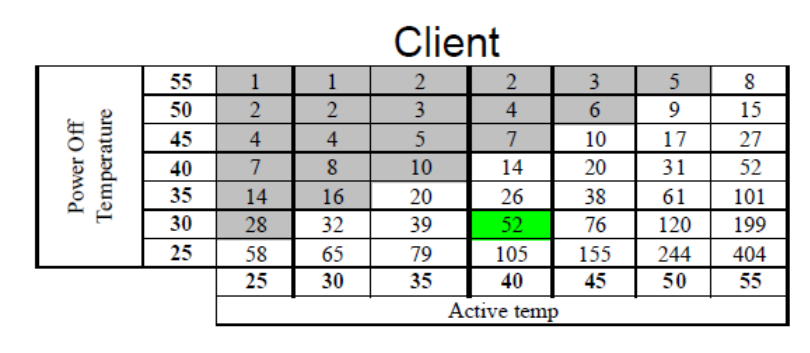
This graph makes me wonder if adding heaters to SSDs would be a good idea.
But I think in terms of longevity for data storage, we really have regressed. The largest number on that chart is only a little under 8 years. I have data much older than that on magnetic media, and it remains usable.
I remember 10 years@10K cycles was the norm for retention specs in MLC NAND... 8 years ago. It changed to 5 years/5K cycles not long after that. Now it's 1 year and <1K cycles?
Fortunately I have an X25-M in my laptop that hasn't shown any problems, but then again I did opt to pay a little more for the model with older 50nm flash instead of 34nm...
People have been pushing for data density far more than data retention. And the smaller the cells get the worse the data retention is. People see "this SSD is x GB and that SSD is y>x GB", and go for SSD number 2, without bothering to check all the specs. (Even if they are checking beyond size, it tends to be mainly benchmark-based - which, again, tends to hurt data retention.)
That can be more difficult to do that you expect. The two primary uses of SSD is datacenter storage, where they can easily control the temperature, and portable devices, where you cannot. Unless you live some place like southern California, you're almost guaranteed to expose your SSD to extreme temperatures. Or if you're working in a commercial environment like a hot factory floor or cold food storage freezer.
The lesson being until SSDs can be made more stable over temperature, you should assume local storage to be unsafe. Design systems with secure remote communication and store your data in environmentally controlled warehouses.
And importantly daya centres tend not to control the temperature for the electronics.
Google used to have some warehouses with human accessible corridors (temerature controlled) and the machines (not temperature controlled). They released minimal details as part of their eco work.
All of the recent data center designs I've seen published have hot and cold aisles, where the AC is blowing into the aisles on the 'front' side of the racks, the racks suck in the cold air and spit it out the back.
I've been in small server rooms that don't work this way and it feels like you're having hot flashes when you move around the room, and eventually someone puts a house fan in to even out the temperatures.
(the aisle segregation isn't actually that new of an idea anyway. False floors with vent holes were created so that you could run the AC under the floor and have it pop up where you wanted to, and most of those holes are in front of racks. Also seems like a convenient place to drop screws and lose them forever.)
"If you buy a drive today and stash it away, the drive itself will become totally obsolete quicker than it will lose its data."
What does obsolete mean in this context? Does he mean the file system will become deprecated by future advances? Or does he mean the size will become insubstantial in comparison to future products?
Except that somehow, data size for some usecases hasn't really increased. My main disk has the same size it had 2009 (and if SSDs didn't happen and had clear speed advantages, it probably would be the same disk it was back then) and I don't see it becoming to small in the next 5 years. So a SSD bought today could be useful spec-wise for 10 or even more years.
New systems are sold with 500 GB (or even smaller) main drives, just like they were back then. Though moving a disk between systems instead of buying a new one is something only people building or modifying their own systems do, true.
NAND Flash can be designed to keep the data longer, but most SSD uses value storage capacity over endurance. Using multilevel cells really reduces endurance because smaller voltage drops will change bits.


My Crucial m4 from 2 years ago, which I regularly abuse - full disk encryption (more random IO), no TRIM (eventually filling the SSD), and I am at 98% life (i.e. I have used only 2%). The retention at this point is much more than a year. Yes, I expect that if I write something and leave my SSD on the shelf it will be readable in 5 years or more.