Remember that 52% of the UK voted to leave the EU which leaves the other 48% hurt that you paint us with the same brush. Such a big decision should have been a two thirds majority. I live in London and work as a software developer for a big investment bank. These institutions are more IT companies than what people traditionally think they are. A huge portion of the floors are for IT developers, a small number for trading and the rest for admin. My point is that the revenue generation part of the bank could move anywhere but the IT remains where they can find a large pool of financial software skills. Here for now.
The big investment banks are struggling to be profitable these days and it has nothing to do with Brexit or the EU. After the financial crisis in 2007 they have had to hold more and more capital and be more transparent about their complex transactions. And rightly so. In order to be competitive they build software that lets them comply with the regulations as tightly as possible, to maximize profit. The more the financial regulators see the more they regulate. Smaller institutions like hedge funds don't bare such a high burden. My building has been quietly emptying out for two years and so are the others. The giants are dying but it's not because of Brexit. I see purely software companies and specialist hedge funds taking over in this area in the future.
Truth be told, Brexit will hurt the EU more than it will hurt the UK and I won't hold any grudges if the EU member states fought hard to defend their union. If they impose punishing import and export duties on us then it will most likely not be out of spite but to protect them from other member states leaving too. Picture yourself on the other side of the fence, what would you do?
And one last thing, the EU was created to economically tie as many countries in Europe together so they would all depend on each other for resources. That way no one country could start world war three. By design it should maintain connections and dependencies regardless of what localized people living in it desire in the short term. Making member states more wealthy and comfortable is secondary.
> And one last thing, the EU was created to economically tie as many countries in Europe together so they would all depend on each other for resources. That way no one country could start world war three.
To me this is one of the most important aspects. It is so sad to see this being unraveled.
I would add the quite inspired Erasmus student exchange program to this - encouraging people to do (parts of) their university studies in a different European country is a brilliant way to perform cross-pollination both with DNA/family ties and ideas. I think this could end up being the most powerful way to guard against future intra-european wars.
erasmus (or orgasmus by some accounts) is indeed the most powerful tool for europeans to unite and figure out that as people we have more that unite us than divide us among nations and different language, manners, you name it...
It's so incredibly efficient that in a worst case, the EU could actually be reduced to being just this program, and still likely fulfill the most important of its goals (peace).
Ergo: UK people, please pressure your politicians to maintain membership of the Erasmus program. (Or something equivalent.)
> Such a big decision should have been a two thirds majority.
If I recall correctly, all advisory referendums in the UK have been winnable by a simple majority.
I imagine there would have been an outcry if the bar for leaving the EU was set higher than 50% of voters, especially because the 1975 referendum to remain in (what became known as) the EU had a 50% threshold to succeed.
It's natural that the people on the wrong side of the result feel a bit aggrieved. This is true in any voting system, for any vote - but can induce relatively severe regret for long-lasting or wide-ranging decisions.
The only solution I can suggest in order to minimise regret is to adopt a strategy of "deciding how we decide" as a preliminary step before the actual vote to decide. (The "Remain" camp were fairly sure they'd win the vote, and foolishly neglected to consider this.)
This approach can also be useful in meetings where a technical decision needs to be made. For instance, it might often be preferable to adopt a consent-based process rather than a consensus-based process. See here: https://en.wikipedia.org/wiki/Consensus_decision-making
Agreeing how to decide something can also be useful in adversarial negotiations, where it is often easier to agree a "fair process" leading to a result than it is to immediately try and haggle about the result itself. (For example: "Will you pay me the average of 3 repair quotes for the damage you did to my car?" vs "Pay me XYZ for the damage you did to my car.")
> If I recall correctly, all advisory referendums in the UK have been winnable by a simple majority.
If "advisory" meant opinion poll, then a 51% result would be meaningful. But as a binding referendum it's ridiculous. We'd never build a control system that flip-flopped wildly at the boundary point the way first-past-the-post elections work.
> The "Remain" camp were fairly sure they'd win the vote, and foolishly neglected to consider this.
It's always the sane people's fault for failing to realize how shitty the trumps and farages are willing to get.
In a practical sense, you're right. When people start racially scapegoating we need to watch out. But in a moral sense, no you aren't right. Their repulsive actions aren't our fault, especially not simply because we failed to stop them.
It will have to vote on the final agreement at the end of the 2 year negotiation, but May is refusing to have it vote on triggering Article 50, i.e. actual Brexit.
Just a little (to me, important) correction: You mean 52% of the UK THAT voted. The turnout was 72%. So 37% of the electorate (not 37% of the population, as a lot of young people that would like a saying in such a drastic change that will affect them the most, couldn't get their voice heard either).
> Such a big decision should have been a two thirds majority
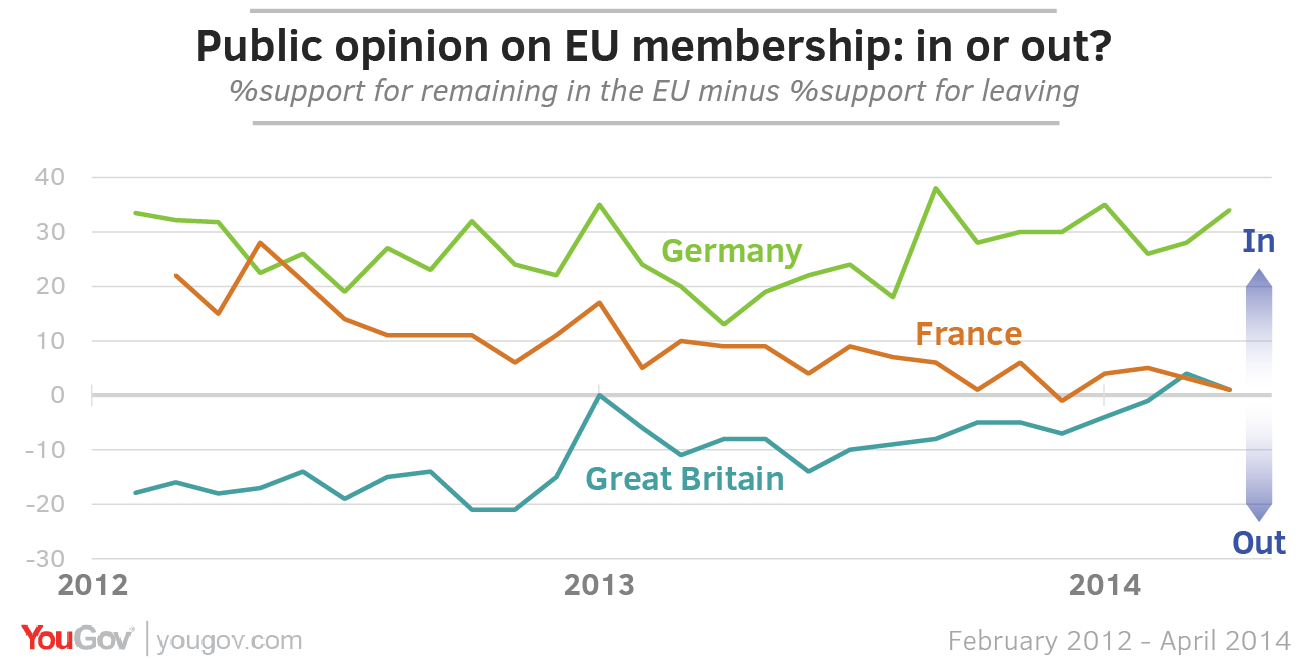
Two-thirds majority may not have been reached this referendum but it would have been eventually. Euro-scepticism has been festering in the UK for some time and is surging in France [1]
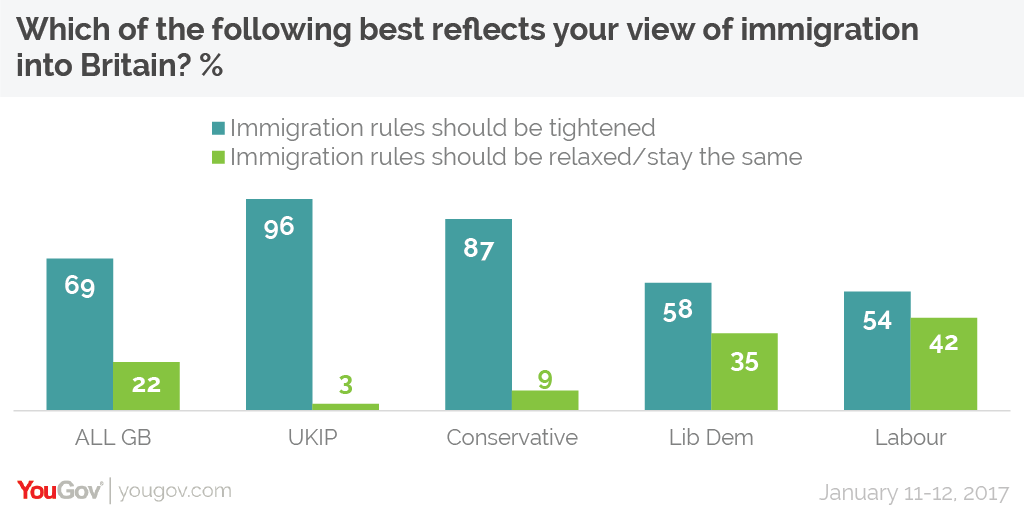
Most of the British public believe that immigration controls need to be tightened [2] something that is not possible when being a member of the EU.
Another thing to keep in mind is that the French Hollande administration will be out of job shortly (in May this year), so whatever they say doesn't matter that much. The centre-right is most likely to win the elections now, and they may have a more business friendly approach to the negociation with the UK.
> Remember that 52% of the UK voted to leave the EU which leaves the other 48% hurt that you paint us with the same brush. Such a big decision should have been a two thirds majority.
Absolutely. This is an example of how unreasonable it is for politicians to make these sort of changes on the weak mandates that they have.
Yeah, I don't want us to allow abortion by 51% either even though I am pro-choice. That doesn't convince anyone and just sets them up to try to repeal it as soon as the sentiment swings 2%.
When a politician elected with maybe 40% of the popular vote, from the 65% of people who vote, gets a 51% advisory mandate from those few who show up to vote in the referendum, it's a pretty weak reason to drag everyone else along. Democracy is built on the idea of false consensus. That once enough people decide on something that it doesn't matter if others do. The closer we go to simple-majority, the worse that is.
fwiw, I find it funny that you think that's conservative. I get more feedback that it's hyper-liberal. I don't think either are correct.
Sorta. But it's not that I think we'd never get 52%. Or 66%. I'm not trying to set a higher bar just to stop political change, but to make it more inclusive when it happens.
To get those higher mandates we'd have to try to pass less-controversial things. Again, not that it's meant keep us here as if this is a special reference frame that I cherish, but that it would force us to reach out to both sides and find change everyone can support.
Both parties in the US election were looking to force their politician on everyone else. A healthier answer would be if we picked everyone's compromise president. But first-past-the-post is designed to produce all-or-nothing outcomes.
Politics, along with Civics, Ethics and Financial Education should be a mandatory part of our education system from the beginning of secondary school.
The cynic in me might suggest that it isn't because having the people uneducated on these matters greatly benefits a certain wealthy and influential section of society.
They are forgetting the main problem: Traders/Bankers (for the most part) want to live in London, not Paris.
It is similar to the article on HN a few days ago shttps://news.ycombinator.com/item?id=13426822aying Montreal is taking over AI. That is highly unlikely to happen as programmers rather enjoy California.
It's interesting how perspective matters so much. I grew up in Ontario, work for a tech startup here. One visit to silicon valley convinced me that I never want to work there. I hated the culture, I hated the lazy weather and accompanying attitude. I hated driving everywhere. I hated the prices.
Winter is probably a huge shock to many, but I think it builds character and can-do attitude. Plus hockey.
I have a hard time believing that you can gather that much about "culture" from one visit.
I spent two months living in Toronto again as an adult after 10 years living in Mountain View and then San Francisco, and I hated:
- the lack of interesting tech jobs
- the lack of culture
- the terrible weather with no upsides (Ontario is so topographically boring and you have to get on a very expensive flight to get anywhere interesting)
- Wine: Napa, Sonoma, Paso Robles and the surrounding areas of each.
SoCal gets a lot of that too, but usually more driving/flying involved.
You also don't get very extreme weather, but you do get earthquakes.
All-in-all, I'd say CA scores really well for all kinds of active lifestyles, but the big negative is the cost of living coupled with CA taxes. If you don't mind a bit more cold and fewer jobs (slightly fewer?), Seattle becomes super appealing.
Outside of some silly things that the CA gov does (why does everything cause cancer lol? Why are there like 15 transit agencies in the bay area?) my move to here from Texas was like seeing what the world can really be like. In Houston, if I wanted to hike, I had to wake up early and make a 2 hour drive for the good ones. Might as well just go on to Austin. If I wanted to camp, there was ONE good place within an hour drive, otherwise, going on up to Austin or Enchanted Rock.
But in mountain view, I can go straight from work to Rancho San Antonio. If I'm feeling a one nighter backpacking trip, Henry W Coe is an hour and a half drive. Big Sur. That volcanic area north of Berkeley. Dayhike opportunities are too numerous to count. I love it.
Because with 150k signatures, you can get any weird ass proposition you want for a state-wide vote. And in 1986, voters decided that we needed to be warned about every little thing that might cause cancer.
Prop 65 has nothing to do with the CA gov. It's the voting public that made it happen.
I also grew up in Ontario (Toronto), but I work in SF for a tech company. I've lived in SF for 4 years, and before that lived in Toronto.
I love the sunshine here, the lack of snow, the lack of having to shovel driveways, the close proximity to stuff like hiking and skiing if I want to, the relative lack there of extreme weather (hot or cold). I can go running outdoors 12 months a year.
I don't own a car, and I don't have to drive anywhere. I have good work-life balance at work. They pay me a lot, even after taxes and cost of living (much more than I'd get in Toronto).
That being said, I wouldn't want to raise kids here. And the poverty/crime sucks a little bit.
I can't wait to retire to the suburbs of Toronto and raise some kids when I'm 30 :).
Winter is also more manageable (or entirely enjoyable!) if you simply leave the house. Buy proper clothes, learn to layer and find something you enjoy doing outside (hockey, skating, skiing, camping).
I too would go crazy if I stayed inside for months.
Exactly - when the weather report says "its dangerous to go outside" and "exposed skin will freeze in less than 1 minute", there's no amount of clothes that'll save you.
That Scandinavian quip has become a popular soundbite but they have a fairly stable climate, with only extremes of temperature and snowfall as a consideration in the most northerly regions. Their winds don't reach hurricane-force on land, which is fortunate as no clothes can help in that event.
For the most populated regions their climate is maritime mild-temperate ( to the west ) and continental ( east / south ) due to the Gulfstream. Certianly more mild than other regions at the same latitudes.
I wouldn't take their weather advice if I was going to Siberia, for example: average winter temperature in some areas there is -50 Celsius, which freeze your glasses to your face.
This is entirely true; however, most "bad" weather that keeps people indoors can be made very comfortable with an investment in a few pieces of appropriate clothing and a willingness to learn how to dress and stay dry in winter weather (which, I suppose, I'm defining as weather typical of northern US/southern Canada - not the Arctic).
Obviously there is extreme weather, but bad weather is wind,rain,snow,hail etc. Extreme weather is 3+ foot snow drifts, -25c daytome temp, 40+ mph wind, cyclones etc.
Depending on you, winter is more enjoyable when there are people on the streets. In bay area, this means most seasons are never "enjoyable" since all you see is cars
As I live in Minneapolis, I can assure you that the community continues to take advantage of the outdoors during winter - including a not insignificant number of bicycle commuters.
I have lived in MPLS and the bike scene there actually tiny compared to a real bike city like Boulder, Copenhagen, Tokyo... In MPLS they like to think that they bike a lot, but I just don't see it. In the winter almost nobody bikes, there is maybe 100 people in the whole city who do.
No doubt, but the American Community Survey still ranks Minneapolis relatively high for cities that commonly receive snow. Boulder is indeed higher as a percentage of population, though not in absolute number of bicycle commuters.
That's also tangential to my point - people can get outside and do stuff in "bad" weather if they want to (and will probably be happier if they do so).
and snowboarding/skiing, building snowmen. weather (i.e varieties of it) is actually great, hot and sunny every day and spending a fortune on AC is not that appealing.
Snowboarding/skiing options are a lot better in California than in Ontario. You can drive to Tahoe or you can cheaply and quickly fly to Utah (or Denver, Seattle, Jackson, ...).
(Source: I grew up in Toronto and lived in California for 10 years)
I love the weather in California, and in some areas of CA I really like the culture. Just not LA, MV, PA, Frisco. The prices suck and you do have to drive a lot. But we have those same two problems in the GTA (housing and car travel).
> Traders/Bankers (for the most part) want to live in London, not Paris
Traders and bankers, for the most part, want to work where they can make money.
My old firm's trading floor was in Connecticut. I, like most of us, preferred to live in New York. That meant hours-long commutes. On one hand, the firm had to pay us more to compensate for this. On the other hand, that amount was minuscule compared to the value we produced. This arrangement persisted--and continues to persist--despite New York City being both the economic and cultural centre of the Greater New York Area.
Comparing London --> Paris to Silicon Valley --> Montreal is unfair. With the former, a material change has occurred to the attractiveness of London. With the latter, no such change has happened. A better comparison would emerge if California started seriously debating a large tax on California-based start-ups, expected to go effective in some unknown form over the next few years.
They prefer London because the jobs and the money are there. Will they prefer it in the future? Who knows. Plus, Paris is more beautiful and enjoyable (subjective, but I'm sure most would people would agree).
I would imagine language and culture play a significant role as well. If English is the language of banking business, then living in a place where English is spoken all around you would be a big consideration.
Not as much as you'd think compared to the UK, when it comes to income tax for example. In the UK, you hit the 40% bracket from £43K, in France that's only at €71K ! Granted, France has a 30% bracket from 26-71K€, in the UK it's 20% from £11-43K.
Capital gains taxes are slightly higher in France, so is corporation tax for big companies (much higher), and there are definitely higher labour taxes on French salaries, but there's no comparison in terms of what public services you get for that money (it includes unemployment insurance, child benefits, comprehensive health care, and a state pension you can actually live on, amongst other things)
I'm not sure what you mean by "20-25% layer", but there are other taxes besides income tax in the UK too : National Insurance contributions, Dividend Tax, Capital Gains Tax, etc.
Overall, it's definitely less in the UK, but not enough to warrant saying French taxes are "through the roof" compared to them.
In the UK. The income tax and the NI are both applied at the same time as a percentage of your gross salary. (Basically 20+11% or 40+2% if on the high tax bracket).
In France. The taxes are layered. There is your gross salary, then one tax is applied (25%)... then another tax is applied (11-45%) on what's left ... then it keeps going on.
I think most people don't like French people, because they are arrogant, have a hostile attitude and are not welcoming and they refuse to speak the world's no. 1 business/internet language which is English (subjective, but I'm sure most people would agree).
EDIT: This was an extreme sarcastic comment in response to the original comment above:
> "Paris is more beautiful and enjoyable (subjective, but I'm sure most would people would agree)"
It was my intent to play an extreme stereotype in response to the comment from above, because I found it funny to be honest how someone can even say that. Anyways, continue downvoting...
"Everyone" is a strong word, I know people from Paris that live in London and struggle. I'm sure the number of people that speak english is rising every year, but definitely not "Everyone"
I don't think bank employees would necessarily be averse to Paris (as opposed to, say, Frankfurt which is making similar plays for them), but I'm pretty sure banks as employers wouldn't want to go anywhere near French labour law.
There is a 2hr train from London to Paris. It is possible that some traders would commute that, it isn't an unheard of distance. It would be tricky without freedom of movement etc, but it is doable.
I did that for 3 months. Freedom of mvt isn't the problem (the UK being outside of Schengen, you always had passport controls). But it is extremely tiring on the long run.
I agree. There are a lot of people already who commute to London from, say, Manchester on a Monday, and back on a Friday, and stay away for the work-week. That is also a possibility
Yep, my father in law used to work at the Bank of England and commute 2 hours each way on the train tp be at his desk for 7:30 am and home for 8:30 pm - horrible but doable
My commute is between 1 to 2 hours depending on the day and time and I am only traveling 40 miles. I'd rather take a train for two hours seems certainly doable.
You have to get 45 minutes earlier at the station for passport and luggage control. And you also have to factor the time to go from home to St Pancras, and then from Gare du Nord to your office.
Doable for short time, but you also have to get to and from the Eurostar train stations. For me it would be 2 hours just to get to Paddington...
But if you have an office close to Gare du Nord and a flat close to Paddington or opposite then it is workable. And one train journey commute without changing trains is enjoyable. (ie sleepable/workable)
Doh, that is what I meant, no idea why I kept saying Paddington. Still upset it is not at Waterloo any more. That would have made it more attractive option for me.
Will have to endure that train, tube, another tube or walk, then eurostar with all the kids & luggage entourage for a Disneyland Paris trip in a few months.
Bankers are often pretty well paid, and probably would be compensated (at least in the short term) for inconvenience and cost, until they can be relocated or similar
Having lived in both, I much prefer Montreal. The place gives me more joy and pleasure, and I'm happier there. It's mostly due to the people and their attitude towards life. Montrealers just want to have fun and be in good company.
That said, jobs, pay and weather are better in California.
While Brexit is, quite possibly, the dumbest thing I'm probably going to see a nation state do in my lifetime, it is fascinating to live in London while it all explodes.
Cameron, surely, will have to go down as one of worst, most narcissistic leaders in the 21st Century. If not, it's a hell of a bar he's set, staging a vague refendum, excluding the people who it most directly affects (UK nationals in the EU) from voting and not including some kind of confirmation option.
Saddest part is the delusion of the British ruling class. That they think they're somehow going to matter more to the world as a small partner to China/USA rather than as a dominating member of the EU is hilarious if it weren't so sad.
For context: I'm a NZer living in the UK. We're a small country at the mercy of big countries with little actual power. That the UK elected itself to be like us is just ridiculous, but c'est la vie.
They will likely move the front office staff only. Middle and back office are likely to be less affected. Salary-wise this is likely to be a disproportionate % than 2%.
Exactly. They even announced they weren't going to move headquarters to Hong Kong (which is the only real alternative for HSBC, lets be honest) before the referendum result, saying it was mostly irrelevant.
Yes they may move some trading desks. So what? Banks do this all the time. Take for instance ING which is moving ~60 trading desks to London from Netherlands, despite Brexit.
The fact he's announced Paris as the destination seems to indicate to me he hasn't put much serious consideration in to it.
So don't worry about the 1,000 HSBC (and other bank's) traders that will have to move if we lose Passporting. It's OK because we're getting 60 from the Netherlands.
I don't think London's status as a financial hub is seriously under threat. Most of the business we do doesn't rely on EU financial services passporting rights. But that part which does will have to move, if we lose those rights. For example clearing trades for exchanges on the continent is another area where London has hoovered up most of the business from across Europe, but those gains will have to be unwound if we lose Passporting.
No passporting rights exist for third-country firms under MiFID, but the position is set to change when MiFID II and MiFIR comes into force from 3 January 2018.
Interesting, I wasn't aware of that thanks. I just did some reading up.
However it looks like to be eligible the UK would have to effectively rubber stamp all the EU's financial services regulations into UK law, but of course without any of our current influence as a member over drafting it. So much for winning back Parliamentary sovereignty!
I can't find the source atm, but there was an article on how it would take 300 years for schools in Paris to fill the admissions required for children of bankers.
You may wish to check the EU Financial Services Passporting regulations; in particular the supervision of "significant-plus" branches and the Technical Standards for information exchange between the home office and the branch offices (if any are in the EU), and supervision of those offices and relevant local authorities.[0]
1. Passporting isn't required for all banking activities. It is required for sourcing certain capital, for example. You can still have plenty of people in London, without access to the single market, handling capital of investors in the EU.
2. Paris (France), really? They are as anti capitalist as they get. Just look at the wealth tax thing only a couple of years ago. A gazillion little things like that exist in France.
I mean, I love the country, but no, just no. It's not a place you go to run (or found) any business, I would say. There would need to be a very good reason to do so.
It has grown historically into a financial center, yes, over centuries.
But how many executives (that aren't french citizens) are deciding today that they want to base financial firms in Paris and live there, over London? The UK is much more pro business than France is. And it still will be, even after Brexit.
I love both cities, but you just can't put them next to each other (for finance) and expect Paris to win on the professional end, in my opinion.
Seeing the comments, many people are still in denial that some finance jobs might leave London this year.
This seems strange, considering that even the Prime Minister's position is that keeping those jobs is not a main priority. She has said that very clearly.
Such announcements are only hot air as far as I see this. For the next 2 years London will be in the exact same position as it is today in terms of trade. The Prime Minister seems confident to work out a great trade deal for London. Any bank which announces today that they are moving staff today (because of Brexit) is just looking for a headline, because a smart manager would wait long enough to see what the trade deal with the EU will look like before making any premature decisions. Moving anyone in 2017 is therefore stupid when everyone knows that after triggering article 50 there will be 2 more years guaranteed to trade under the same conditions as they are today.
It says 20% of its london revenue, but I was only able to find its worldwide revenue ($60bn for 2015), anyone know what the London specific revenue was?
Context: the UK government has decided to abandon the single market. Businesses are currently lobbying (very stongly) for this not to happen. That's not to say there's not merit in their arguments, but I would take the figures with a pinch of salt.
In my earlier career I would have loved to earn London salaries and live in Paris. Paris is - well Paris. An amazing place to live.
London is grim and grey with eternal darkness in winter (if you are working). Paris is 200 miles/350km South and with much better access to the rest of Europe, mountains, beaches and so on. So if I was at HSBC I would jump at the chance.
Meanwhile HSBC are probably aware that they can pay people less in France than they need to in London - for the reasons above.
Stupid question: Would anyone be interested in seeing graphs on revenues (and tax brackets, and explanation on these tax brackets) for London/UK and Paris/France?
don't you worry, bojo is on the case right now. The UK will have to accept more visas from India to get a trade deal. Replacing Europeans IT workers who were able to negotiate their salaries with low wage IT workers who can't change jobs at the risk of loosing their visas...
You're right for IT positions in Banking in London but for the rest of the country its a different story. Though I remember the big outage due to a botched upgrade of a batch processing software done by a junior developer in India http://www.telegraph.co.uk/finance/personalfinance/building-...
The two parts of your sentence contradict each other; a statement of fact must describe a past event (we moved our office) or current state (we cannot stay here due to Brexit). "We will move the staff" is a promise or a prediction, but it has not happened yet.
That's not entirely True. "I intend to leave the office at 5PM today" is a statement of fact, it is neither True, or known to be True (epistemological the same) only once verified to some standard. You can assume "I intend" == "it will happen", but that's not a strongly accepted assumption.
It's fascinating how the group dynamics of this whole situation work out.
London provides enormous amounts of financial services to Europe. Around 35% of all wholesale financial activity in Europe takes place in London. Around 85% of European hedge funds are there. Around 44% of all worldwide euro trading takes place there and around 70% of all derivatives trading. Figures from https://www.thecityuk.com/assets/2016/Reports-PDF/The-UK-Eur...
In other words European companies rely heavily on people who currently live in London and presumably are settled there.
In any normal situation this would be seen as "The EU wants access to London based services, we'd better make sure we negotiate that!". However that isn't what is happening. Instead the EU plans to simply pass new laws (changing the MiFiD II rules that aren't even implemented yet) in order to force the people who live in London to sell their homes, pull their children out of school, learn new languages and move elsewhere. The banking industry is resigned to this fate and barely even comments on it.
To me this is indicative of the terrifying fanaticism at the heart of the EU. Talking about it is one of the taboos that Brexit has started to break. The people who run the EU are utterly, utterly unconcerned about the lives of the people who work in finance, they're utterly unconcerned about the economic welfare of European companies that heavily rely on the UK for financial services, they've refused to take up Theresa May's offer of ruling out forced expulsions right at the start, and their "plan" appears to be to refuse to negotiate any kind of cooperation at all until after the two year exit period is up.
This is not what responsible, mature leadership looks like. This is what it looks like when people get it in their heads that they can do anything and nobody can stop them. You can always tell when there's a true fanatic in the room because the reasonable people start blaming each other for the "inevitable" consequences of trying to defy the fanatics. Their unbending will regardless of the cost comes to be seen as a fact of life that just has to be accepted, and everyone else starts to work around them and even blaming themselves for it.
Europe will become a healthier place when people in positions of power and respect start being able to say that the EU is run by fanatics.
> (...) in order to force the people who live in London to sell their homes, pull their children out of school, learn new languages and move elsewhere. (...)
Please, stop that. I am an EU national that works and lives in the UK. There's 3 million of us. Among my anecdotal data, 2 families have left already - the rest of us have been postponing / stopping for undefined time buying houses, cars and doing any long or even mid term planning.
This is all because the UK citizens, plus the Irish, plus the Commonwealth citizens (that may or may not have right to live and work in the UK) voted and decided we were not worth it. As simple as that. We, of course, didn't have the right to vote.
Don't even dare to use the "poor families" argument on this.
> (...) The people who run the EU are utterly, utterly unconcerned about the lives of the people who work in finance (...)
You can't be fucking serious mate.
Whoever voted Leave in the referendum holds no moral ground to bring in these arguments.
Edit: This comment's score is like a rollercoaster! Whoever is downvoting me, could you please please understand for a second that most of the people working in the financial sector had a vote on Brexit (as most people in the UK had), but 100% of the people that are now in a legal limbo had no vote on Brexit? Ok, thanks.
You don't even consider that maybe the EU could just ... not do anything. There is no problem with euro-related transactions being handled in London. The vote was not a decision that you weren't "worth it". It was a decision that the EU is a problem and needs to be got rid of.
But in a classic show of why the decision was correct, instead of blaming the EU for imposing trade sanctions on your industry, you blame the UK for voting to leave even though it's entirely the EU's retaliation that is to blame for your predicament. There is nothing that requires them to block Europeans from trading with the UK.
The EU's actions are not inevitable. They are deliberate, spiteful and driven by the fear of a loss of political power. Take your anger to Brussels.
> You don't even consider that maybe the EU could just ... not do anything.
"Not do anything" means the UK is not part of the EU hence the UK has no trade deal with the EU. The defaults are WTO rules, which is TARIFFS and no passporting just to be over-simplistic. The WORST deal for everyone.
> There is no problem with euro-related transactions being handled in London.
There is. The EU would actually need to change the law to allow London to keep operating while not being part of the EU.
It is the UK who's leaving. Why do you try to paint it as retaliation?
> The vote was not a decision that you weren't "worth it".
Yes, it was. EU immigration was a big part of the vote and the other, namely what you wrote --> "It was a decision that the EU is a problem and needs to be got rid of." is the "not worth it" part. For you, it's not worth to keep us around. I respect your opinion, but please also respect my distaste for it.
> But in a classic show of why the decision was correct, instead of blaming the EU for imposing trade sanctions on your industry, you blame the UK for voting to leave even though it's entirely the EU's retaliation that is to blame for your predicament.
It's not trade sanctions, it's the lack of a trade deal. You must have been supermad at Makro when you stopped paying for your membership and lost your right to buy there, right? Those filthy revengeful Makro workers, imposing trading sanctions on YOU nonetheless!
> The EU's actions are not inevitable.
Agreed. The UK just has to reach an agreement that satisfies both parts.
> They are deliberate, spiteful and driven by the fear of a loss of political power.
No, they're not. The UK's decision to eat their cake and have (which you don't seem to be able to grasp - where does this delusion come from?) is the only deliberate and spiteful action here.
> Take your anger to Brussels.
Good luck for the future. You're going to need (and what's even worse - I'll need it because of delusional people like you as I live in the UK too).
i also think it's funny he's trying to make us feel bad for people in finance. some of the most morally bankrupt people in the world. especially at hsbc.
> Instead the EU plans to simply pass new laws in order to force the people who live in London to sell their homes, pull their children out of school, learn new languages and move elsewhere.
I think you've got this the wrong way round. The UK voted to leave the EU, and its not like nobody in the run up mentioned that it might lead to companies leaving the UK for EU countries. We made this bed. Time to sleep in it.
There is no actual, fundamental requirement for anyone to move anything anywhere in the wake of Brexit. The reason people have described this as "inevitable" is because the EU can be assured to mandate it, even though they don't have to, even though other regions don't mind having financial services provided by the UK.
You're treating the EU's behaviour as if it's the laws of physics. That's how you know that there are fanatics in the room: people stop treating their behaviour as something that can be reasoned with, and start treating it as if they were some artifact of natural laws.
The EU actually means something, though. It's a shared economic system. The UK is the one who's choosing to leave that system. So of course that means that ... drumroll please ... they're actually going to leave that system, which means that jobs that work inside that system now have to move somewhere else since London won't be in the system anymore. You're twisting yourself into knots to somehow pin this on the Europeans.
British people are Europeans as well. EU <> Europe. Leaving the EU <> leaving Europe (and I am not even British, but it still annoys me when people don't know what they are talking about)
Did you reply to the wrong person? I'm not talking about Europe, I'm explicitly talking about the political entity known as the European Union, which the UK is leaving. I said "EU", not "Europe".
If we are playing soccer and you want to join but are refused repeatedly because you want to play handball (Charles de Gaulle vetoed the UK entry twice), then you somehow sneak into the soccer game and then decide to handle the ball, then, to quote the Simpsons: "that's a paddlin'".
I'm exaggerating for effect, but the EU has a clear set of rules. It's not fanaticism, it's called "working together". The UK, not the EU, decided to stop following the rules. It makes no sense for the EU to bend the rules.
While I don't agree with most of your post, I agree with one thing - the EU are, and should (must) make an Example of the UK, or I think the union will fall apart after votes in e.g. Italy.
Whether or not the EU should in fact try with any means to keep the union together is another question of course. But; assuming that's their goal, then I consider it pretty reasonable to a) try to rob London of as much financial business as possible by scaring large corporations into moving to EU cities b) scare other countries into not leaving the union by demonstrating a bad deal for the UK c) set tough positions before the Brexit negotiations start (which may be loosened during the actual negotiations).
As a citizen of another EU country, I completely back what the EU is doing centrally at the moment, that is, I care less about the lives and careers of london financial workers, than I do the future integrity of the union. I completely agree with statements like "They voted out and there has to be consequences". Not because it is axiomatically so, but because I think tough consequences are the right choice
What if the EU realises that even if both walk away as winners no one will easily follow the UK, because frankly no other EU member state is in a similar position to the UK?
There's only 9 member states who didn't adopt the Euro, so basically everyone else already disqualified to leave the EU. When you look at the remaining 9 (Bulgaria, Croatia, Czech Republic, Denmark, Hungary, Poland, Romania, Sweden, and the United Kingdom) there is either no appetite for an exit (Sweden, Denmark) or the country has simply no leverage at all.
So would the EU risk to fall apart when the UK gets a good deal? Nope.
If Austria or Italy had referendums that decided to leave the EU they would do so (And leave the Euro at the same time, obviously). Whether or not it's technically o legally possible to leave doesn't really matter.
I don't consider it likely but I also don't consider the current political climate "rational", sadly.
The Eurozone is really what should be dismantled, because it's flawed by design. I'd hate to see the union itself which is originally a peace and trade project disintegrate because of a flawed currency and disagreements on people movement.
The point is not if another country like Austria or Italy would/want to have a referendum. If a country just dislikes the EU and wants to leave then the outcome of the UK/EU deal will not make a difference.
What matters though is if another country thinks they can leave the EU with the outlook of a "better" deal outside the EU. The EU would fall apart if countries would believe that, but what I tried to say is that the EU doesn't really have to fear that, because no other country is even remotely in the same position as the UK, so the chances of a "better" deal outside the EU are almost non-existent, because the fact alone that they don't have their own currency would makes significantly more difficult.
Therefore the EU can actually work out a good deal for the UK and the EU without jeopardizing the EU membership of others. Makes sense?
I think the driving force for a leave vote anywhere, just like in the UK would be immigration mostly (ironically perhaps mostly non EU immigration fear, which is hardly a EU matter) and pure populism in the form of "we don't want to be governed from Brussels". The question is just if the fear of the (economic) consequences outweigh it. I fear that voters of several EU countries would accept severe economic consequences, or at least the risk thereof, because immigration or because Brussels.
Italy won't vote out because of a "better deal outside" (nor do I believe the UK did!). They'll vote out if populists can convince them there will be fewer immigrants without disastrous economic consequences.
In Italy referenda on international treaties are prohibited by the constitution.
The only option is an ad-hoc constitutional law that allows for a specific (non-binding) referendum and requires a large (2/3) majority on the parliament. Interestingly, this was last done in '89, to vote to transition from the (economical) European Community to the (political) European Union.
You see, this sort of thing doesn't make self-proclaimed "European citizens" popular in the UK.
The EU should stand or fall on its own merits. The moment people start to think, we have to make it painful for people to leave, it loses its legitimacy. It is on the way to be a new USSR. And if one day continental Europe slowly turns into a military dictatorship (it is effectively already a soft power dictatorship) I will not have any sympathy for whatever happens to people like you.
> You see, this sort of thing doesn't make self-proclaimed "European citizens" popular in the UK.
I didn't mean that in the sense of being a cosmopolite euro-citizen, I simply meant I'm a resident of an EU country other than the UK.
I have no wishes for consequences as punishment alone, I only want consequences in the sense that benefits such as low trade barriers should be shared among those who create them and share the burdens, e.g who accept strict common envirinmental regulations and allow freedom of people to move.
Of course countries would prefer the benefits of a collaboration/union/pact/ without the responsibilities and costs.
But this is my point - the EU is a project to try and force people to accept ideas they think are bad ideas by artificially tying them to cooperation and trade. Instead of letting each idea be individually tested in the marketplace of debate and experimentation, the EU simply insists that if you want A, you have to do B and C regardless of merits.
EU leaders like to paint people who reject this approach as shirking their "responsibilities", or "cherry picking", or whatever other dubious analogy they came up with today. But it's just psychological manipulation. If citizens of a country are overwhelmingly convinced that freedom of movement makes sense only for similar economies, or only up to a limit, etc, then it's not the EU's place to blindly insist that they obey. It's the EU's place to convince them they're wrong, if necessary, by letting them go their own way so some years later the results can be compared. That is how you build trust and loyalty.
You know, 18 months ago I was vaguely pro EU. Like most people I had not thought about it much, in truth. The UK referendum forced me to do my research, to spend a lot of time pondering the issues, to engage with the eurosceptic arguments. And nowadays I am convinced the EU is doomed. It is a concept so flawed it cannot be fixed. It should be abolished and replaced with numerous multi-lateral treaties between whoever wishes to make them, wherever those countries are located in the world. In other words, how the global system of cooperation already operates. There is no need to artificially tie immigration with financial regulation, or medical approvals with subsidies to farmers. There is no need for a flag, an anthem, an all powerful centralised bureaucracy of people who care more about their pensions than the people they rule.
Europe would be happier, healthier and experiencing deeper cooperation if the EU had never been invented at all.
> the EU is a project to try and force people to accept ideas they think are bad ideas by artificially tying them to cooperation and trade.
That's pretty subjective. But it's at least a way of tying cooperation on difficult areas (migration, environment, aid, other regulation) to positive effects (trade, peace). I'm not saying it's a perfect or necessary setup - but it's a way of arranging things that countries have voted to be part of.
> EU leaders like to paint people who reject this approach as shirking their "responsibilities", or "cherry picking", or whatever other dubious analogy they came up with today.
I think cherry picking is a reasonable description, since with the setup as it currently is (like it or not) member states accept the negative consequences in migration/aid/regulation in order to achieve the benefits. In order to e.g. have all the trade benefits but but accept the environmental benefits or help with migration - you'd be cherry picking. Of course you could argue that these things are independent. They should be tried on their own merit. That it's government overreach to combine. I'm not even going to gave that discussion now (I don't even necessarily disagree) but that's not the situation.
> And nowadays I am convinced the EU is doomed. It is a concept so flawed it cannot be fixed. [...] It should be abolished and replaced with numerous multi-lateral treaties between whoever wishes to make them
> Europe would be happier, healthier and experiencing deeper cooperation if the EU had never been invented at all.
Sure. But a whole different discussion. In such a future or alternative reality we wouldn't need to discuss what the EU does when Britain leaves because there is no EU. It might be the case that the EU is doomed. Or that it is dismantled. But it won't be this year, or the next. So the debate about what kind of agreement will be struck between the EU and the UK is still a real one. These negotiations will take place between the actual, flawed, mega-package-deal EU, and the UK. It's those negotiations I'm talking about, not whether the EU is actually a good idea, can survive long term etc. Interesting, but separate topics.
Verhoofstadt today:
   "it is an illusion to suggest that the UK will be permitted to leave the EU but
    then be free to opt back into the best parts of the European project,
    for instance by asking for zero tariffs from the single market without
    accepting the obligations that come with it."
but also
"The EU must use the UK’s departure to reform and move forward."
Future referendums on leaving the EU, in core EU countries. There are more or less advanced plans or propositions in many EU countries although none have yet had a proper referendum (and doing so in a Eurozone country would be more complicated than Brexit)
Marine Le Pen (3rd party leader in France) demands a referendum. A leader of the 3rd party in Germany (Die Linke) demands the same thing. Luckily these countries are among the least likely to leave.
No offense, but you're a bit deluded and confusing wishes with reality.
Also, you didn't answer my question: What vote exactly? You mentioned Italy, so I guess it had something to do with Italy - however you haven't answered.
I'm talking about future referendums. Those can be held in any European country where either a EU-critical party wins power, or a popular demand calls for it (such calls recently failed in Finland, for example, although a referendum had it been held would never have resulted in an exit).
So to be very clear- There are no planned exit referendums, there have been no other such referendums than the Brexit vote, and without petitions or power shifts there are no such votes on the horizon. So by "What votes" I mean e.g a vote under LePen or the next Italian government.
Not sure what you think I "wish", I certainly don't hope for any such referendums around Europe.
> I'm talking about future referendums. Those can be held in any European country where either a EU-critical party wins power, or a popular demand calls for it (such calls recently failed in Finland, for example, although a referendum had it been held would never have resulted in an exit).
No, you are not. You referenced a vote in Italy. There was a referendum in Italy totally unrelated to any of the "what ifs" you're spilling here.
> So to be very clear- There are no planned exit referendums, there have been no other such referendums than the Brexit vote, and without petitions or power shifts there are no such votes on the horizon. So by "What votes" I mean e.g a vote under LePen or the next Italian government.
What next Italian government? Do you think M5S does even stand a chance?
> Not sure what you think I "wish", I certainly don't hope for any such referendums around Europe.
Europe wants significant financial services provided to European companies and individuals to take place within the EU; just like the US, Russia, etc... Nothing new here, this is exactly why the banks are going along with it. If you want to provide financial services within the EU you need to have an office within the EU and conform to EU regulations; not really that surprising or fanatical.
On a not so related topic, the European Medecines Agency has its headquarter in London. I am not sure they are planning anything but it would be weird if a regulatory agency was working from outside of the area they are regulating.
> The people who run the EU are utterly, utterly unconcerned about the lives of the people who work in finance
Not to be crude, but often these people perform work that's against the public interest. Why should the EU be concerned about their personal well-being? Quite a lot (but not all) of their work is parasitical in nature.
You can always tell when there's a true fanatic in the room because the reasonable people start blaming each other for the "inevitable" consequences
From your post:
The UK voted for Brexit, you just cannot ignore its consequences. Deal with it
London handles transactions for nations and currencies around the world. If other countries had the same attitude the EU does, there would be no such thing as a "financial capital" because dollar transactions could only be processed in the USA, Yen could only be traded in Japan, etc. Nowhere would get critical mass and London wouldn't have any real financial services industry. It doesn't work like that.
What is your suggestion? Should the EU change all their rules so the UK can leave but keeps all the advantages? Like the Brexit clowns promised before the referendum?
There is no fanatism involved. The no deal scenario is optimal for the EU while not so much for the UK. WTO forbids cherry picked tariffs on other WTO members and the EU export to the UK consists mostly of capital goods and final goods (machinery, cars, foods). The UK exports services which Paris, Frankfurt and Amsterdam lobby to get a slice of. Cross-border financial services are easier to restrict.
> changing the MiFiD II rules that aren't even implemented yet
Do you have a link to details? My understanding was that the passporting rule just makes licenses for banking valid in the entire EU (instead of only the host country) and that there are provisions to include countries with rules similar rules to MiFiD outside the EU, and the UK is currently still working implementing MiFiD to make this easy (also they will possibly still be a member state when the rules trigger)
(I admittedly don't really follow Brexit-news, since to me it seems 95% of it is utter speculation. If banks really thought there was unavoidable trouble coming, they'd be moving and not just talking?)
MiFiD II says that any country that has regulatory 'equivalence' effectively gets a financial passport, EU membership not required.
The UK would obviously qualify, as it's currently obeying all the same regulations as other EU countries. The problem is that it's Brussels which decides what 'equivalence' means and it's a black box decision. It can be revoked at a months notice.
You'll notice that zero of the EU's leaders are talking about MiFiD II or equivalence. They're all planning on how to carve up people's lives and jobs instead. It's as if these rules do not exist.
That's not surprising. The EU has a long history of ignoring its own rules when they conflict with political priorities. The best example being that the treaties forbid eurozone bailouts as clearly as it's possible for the treaties to do, but they happened anyway.
The UK is leaving the EU in order to be able to opt to not abide by EU rules.
The UK hasn't a stated position on financial regulation beyond statements about grandfathering wordings until the UK government gets around to changing them, pledges rejecting all EU court oversight and some veiled threats to radically liberalise everything if they can't get the negotiation outcome they wish for.
There exists a provision not-yet-implemented in UK or EU law which would give EU bodies some scope to allow some passported functions to be performed by people outside the EU if the country operating outside the EU agreed to abide by all the relevant EU financial rules to their satisfaction.
Surprisingly, some banks don't find this provision for revocable permission contingent on non-binding commitments by the EU and UK quite as reassuring as the regulatory framework the UK has opted to tear up (particularly not for the staff performing functions not covered by MiFiD II)
And somehow this is the EU leaders "planning to carve up people's lives and jobs"
The level of intellectual dishonesty required to make the arguments you are making is really quite staggering.
It has never been defined. It is a purely political decision, which is why everyone is acting as if it doesn't exist: the EU will never follow the spirit of its own laws if there is perceived political advantage to not doing so.


The big investment banks are struggling to be profitable these days and it has nothing to do with Brexit or the EU. After the financial crisis in 2007 they have had to hold more and more capital and be more transparent about their complex transactions. And rightly so. In order to be competitive they build software that lets them comply with the regulations as tightly as possible, to maximize profit. The more the financial regulators see the more they regulate. Smaller institutions like hedge funds don't bare such a high burden. My building has been quietly emptying out for two years and so are the others. The giants are dying but it's not because of Brexit. I see purely software companies and specialist hedge funds taking over in this area in the future.
Truth be told, Brexit will hurt the EU more than it will hurt the UK and I won't hold any grudges if the EU member states fought hard to defend their union. If they impose punishing import and export duties on us then it will most likely not be out of spite but to protect them from other member states leaving too. Picture yourself on the other side of the fence, what would you do?
And one last thing, the EU was created to economically tie as many countries in Europe together so they would all depend on each other for resources. That way no one country could start world war three. By design it should maintain connections and dependencies regardless of what localized people living in it desire in the short term. Making member states more wealthy and comfortable is secondary.