"Between 2006 and 2014, the commission suspects that the “circle of five” carmakers ... colluded to limit, delay or avoid the introduction of selective catalytic reduction systems (SCRs) and “Otto” particle filters."
I'm not sure this is bad news for Tesla, I'd say it's mostly bad news for the rest of us.
Tesla has reached enough scale to be more or less sustainable (in the sense that they don't need to be posting losses anymore), and I'd imagine they can continue to grow, if more slowly, without the rapid expansion of battery production capacity that this story is about.
But the great aim behind the gigafactory (at least, how I read it) was to drive battery cost down very aggressively, that is, working on the supply-side economics. This would then make EVs (not just Teslas) accessible to more people sooner, without all the subsidies (which have been a demand-side hack that didn't even work very well). If this means a slower clean transition (and I think it does) that's a sad outcome.
Countries everywhere are taking down the subsidizing of electric cars ( In holland called, the Tesla-subsidie). This will hugely effect Tesla sales when they dont have an affordable car.
Its pretty bad news. I think the most important part of the electric car is the battery. Electric cars were more popular that the gas car car a 100 years ago. The crappy battery is why gas is more popular today.
I recently made a 1600 mile trip by car. In all of the places we stopped, I saw exactly one place that had EV charging set up.
Tesla, and non-hybrid EV in general, have a co-dependent relationship with charging stations to overcome "range anxiety". This is especially true for those od us who live in cold climates and must drive in conditions unfavorable to operating batteries, such as -20 to -40 degree weather.
I'm also very curious to see what the electric pickup trucks that all the manufacturers are not-so-secretly working on end up being capable of. A frequent consequence of rural life is needing to haul heavy things, such as wood for repairing out buildings or outdoor furnaces, or towing boats to go fishing.
>I recently made a 1600 mile trip by car. In all of the places we stopped, I saw exactly one place that had EV charging set up.
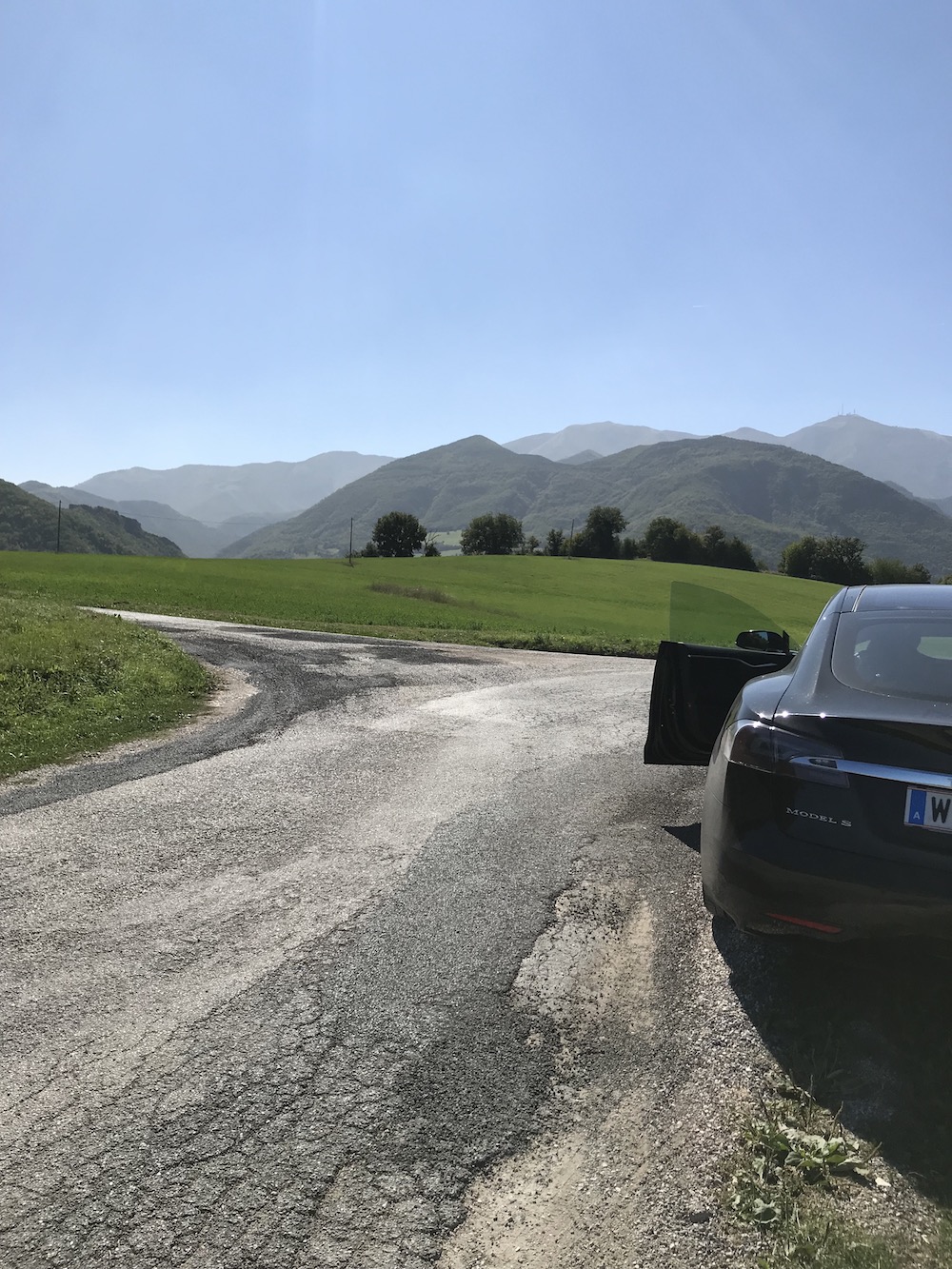
I made a 2800 Km (5 days) trip through Italy a few months ago, it was a breeze with SC and abetterrouteplanner.com, never had to wait at chargers. To give you an idea what kind of roads we travelled: http://666kb.com/i/dxjj2jkx7h0uvhmmg.jpg
Range anxiety: 0. Cost: only road tolls. I can imagine range anxiety and charging costs being an issue with other brands of EV (non-Tesla chargers in Italy are often horrendously expensive) and of course there's more planning involved than with an ICE, but for Tesla owners, this has been a non-issue for quite a while (at least in western/central/northern Europe and most likely the USA).
The USA is huge. Imagine an EU with 50 represented countries, and a common-ish heritage, spread them out across twice the land mass, and you have the USA- lots of cities, lots of land. Just like the EU, different countries (states) have different adoption rates. In short, parts of the USA have much better support and adoption of EV's, and the adoption will likely radiate out from there.
Only limited areas of the USA, as evidenced by my recent trip. That'll change over time, but as you also pointed out with the case of non-tesla chargers, one limitation of EV in general is the co-dependency on new infrastructure.
You can get from virtually anywhere in the USA to anywhere else in the USA using the supercharger network. The problem is you're expecting to see them on every corner like gas stations, but most people with electric vehicles charge every night. They wake up with a full tank. So they don't need charging stations for day to day use. Just longer road trips. So not as many are needed. They're also often tucked away in a hotel parking lot somewhere that you don't notice unless you're actively trying to find it.
> Only limited areas of the USA, as evidenced by my recent trip.
For Tesla chargers, that might be the case, but there are a lot more multi-standard chargers supporting CHAdeMO, CCS1 & 2, etc., than Tesla chargers in the USA. Tesla has the biggest single-owner network, but that doesn't actually put them ahead in infrastructure supporting their cars, because they are the only ones relying on single-owner infrastructure.
I did a bit of research along the route I followed, and the worst stretch seemed to be around 120 miles of no charging stations. The rest of the trip typically had them between 15 and 20 minutes away from the freeway.
If I needed to spend an hour (driving off freeway + charging) for every 200 or 250 or even 300 miles, that would have made the drive far less pleasant.
As someone who also travels by ICE vehicle I don't look for EV chargers and they're not on my mind so I don't see them. That's probably not at all the case for someone with an EV especially a Tesla owner who has that information at their fingertips in the vehicle. I know around here they're at malls, movie theaters and a little more off the highway than gas stations. That said I don't know where you were driving so it's entirely possible there weren't many charging stations around.
Very significant portions of the trip were between large cities. If we had had to zig-zag back and forth between cities with movie theaters or shopping malls that had charges, it would have added a significant number of hours to the trip.
Even with an ICE, there was a (small) amount of range anxiety, in that some areas had 30-45 miles between exits with gas stations near by. Get caught up in a podcast or some good music, and if you're not paying attention, it's not impossible to run out of gas out there.
Better build quality for one. The experience of actually driving a Tesla is undeniably sweet, but the panel gaps, the feeling of cheap half-assedness about details is not (especially at the Tesla price). More broadly price and range need to improve for those of us not willing to spend a premium just because it’s Tesla, and who don’t make only small commutes in a place full of superchargers. For me as well, OTA updates and the willingness of the CEO to go public blaming the driver for an accident is a no-go as well as all-touchscreen controls.
cost (max 15000€/$ for a low end EV)
range (400-500km minimum)
charging infrastructure (at home and on the highway)
charging speed (not longer than 20min)
I agree with this as a dream list (at which point electric cars are better than ICE cars in every way), but we don't need all of them for batteries "to not be deemed crappy anymore"
For me personally, if I can get the first two, then I'll gladly give a bit on the third (even though I regularly do a one-day, 1400km drive and 1-hr charging times would slow me down dramatically).
Tesla right now has the range pretty alright, and the charging speed not bad (but not close to your 20 min full charge), but the cost is just too high. I'll keep driving my 7 year old Yaris.
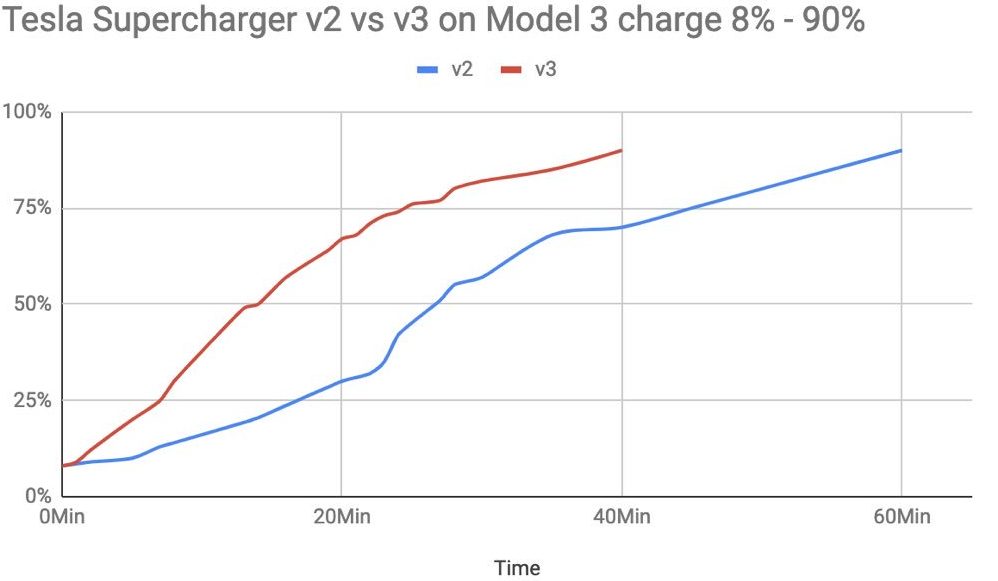
The Tesla Supercharger v3 DOES achieve this. Can do >210 miles of charging in 20 minutes. 67% state of charge on a Model 3 LR in just 20 minutes, which works out to 210 miles of range on the EPA standard, and about 400km of range on the European standard. The Tesla Supercharger v3 DOES achieve this. Can do >210 miles of charging in 20 minutes. 67% state of charge on a Model 3 LR in just 20 minutes, which works out to 210 miles of range on the EPA standard, and about 400km of range on the European standard. https://electrek.co/2019/03/07/tesla-v3-supercharger-action-...
I think you've got a formatting issue doubling up your comment.
That graph shows it charging from ~10% to ~65% in 20 minutes - assuming that is a long range model, that works out to (523km*0.55=) 290km range in 20 minutes.
I know Supercharger v3 is great, and i'd be satisfied with that speed (as I stated). I was replying to someone who wants sub 20 minutes for (what I assume to be) a full charge.
Other than the cost one, Tesla has achieved this, as I pointed out below.
Reproduced here: The Tesla Supercharger v3 DOES achieve this. Can do >210 miles of charging in 20 minutes. 67% state of charge on a Model 3 LR in just 20 minutes, which works out to 210 miles of range on the EPA standard, and over 430km of range on the European standard. The Tesla Supercharger v3 DOES achieve this. Can do >210 miles of charging in 20 minutes. 67% state of charge on a Model 3 LR in just 20 minutes, which works out to 210 miles of range on the EPA standard, which works out to about 400km of range in 20 minutes charging on the European standard. https://electrek.co/2019/03/07/tesla-v3-supercharger-action-...
I think the Chinese operations are going to source batteries in China. Not sure if that means battery production in gigafactory 3 or not, but it should mean lithium ion production should continue to expand. Not to mention all the new entrants into the EV market. Lithium ion battery production should continue to increase and bring prices down. I'm hoping we see a $25,000 BEV with 200+ Mile range in the next 5 years.
> Tesla has reached enough scale to be more or less sustainable (in the sense that they don't need to be posting losses anymore)
I really wish that Tesla had reached that point as that would mean that it's almost possible to profitably produce electric cars, but they clearly haven't.
Tesla itself don't have to be the ones manufacturing the batteries. Given that manufacturing seems to be the part of the value chain that Tesla is the worst at, I don't think the gigafactory was ever going to be that valuable or effective anyway.
Their battery factory is Tesla's primary competitive advantage. They are far ahead of almost any other manufacturer in terms of battery chemistry (<3% cobalt [0], less lithium, etc) and battery pack manufacturing (first to do thermal management -> long battery life).
I think when I did the numbers for our heat pump, a catastrophic leak that would release all its refrigerant would result in a GHG contribution equivalent to a year of emissions from our (previous) natural gas heating. Can't find the figures now so do check before quoting me on it ;)
Alternatively, Mitsubishi has been selling a first-generation product that uses CO2 as the refrigerant (the QUHZ model). It posts a COP of 3 for producing domestic hot water (that's pretty good) - I'm not sure why they don't post the COP for room heating, maybe it's not great. But I'm curious what the second-generation product will do!
I've done some theoretical work in this area. The main problem is that most hydronic (water based) heating solutions return fairly 'hot' water after heating the space. In order to get the most energy out of your CO2 refrigerant gas, you need your other heat exchange fluid to be as cool as you can manage. A designer could choose to use a different style of radiator which would allow the water to get closer to room temp, but that is not the type of system currently being manufactured. This would also not work for in-floor heating, as you would have parts of your floor very close to room temperature, not what people expect (warm floors).
These problems really aren't specific to CO2 hydronic systems, and also appear with HFC refrigerants when heating water. CO2 is actually very good for domestic hot water production, where the hot water is not returned.
The problem is really that hydronic heating is a bad fit for heat pumps in general. You'd much rather heat air, and skip the secondary fluid loop.
I recently toured a municipal heat pump plant. It took cleaned sewage at IIRC 12C, dropped it to 6C or abouts, and the heat was pumped into the district heating network at about 90C.
The plant had 6(?) pumps, each producing 18 MW heat while pulling 6 MW electricity (and also some district cooling). Not CO2 though, each pump had 9000 kg R134a as the working fluid.
Interesting, sounds like a water to water heat pump (takes heat from sewage and pumps it into district heating). Just to dig into your example a bit: It kind of depends on what the return temperature is of the 90C heating fluid is. Based on the refrigerant and COP of 3 (18/6), its probably around 50C. If they were able to find a use for the process fluid so that it returned at 20C, they would probably have a COP closer to 5. You can still build 'relatively' efficient heat pumps for hydronic heating, but they would be significantly more efficient if we did a better job dumping all of the heat from the water (which would require a larger, more effective heat exchanger).
Edit: I guess what I'm trying to say is that most of the radiator technology we use (like the in room part of the heating system) was designed with combustion-based heating in mind. Combustion based heating sort-of works just as well if the return water is 50C or 20C, but you would get a substantial boost in heat pump hydronic heating performance if you were to redesign heat exchangers to get as much temperature out of the fluid as possible. This is an optimization problem: as you increase the size of the heat exchanger, it gets more expense, but improves performance. There is an optimum in there somewhere...
In general, the evolution in district heating networks is towards lower temperatures, allowing better efficiencies with things like heat pumps. As you say, integrating heat pumps into existing district heating networks designed for combustion based heating is suboptimal, but redoing the network for lower temperature operation is incredibly expensive as well.
Currently, in the case referenced above, during the winter the heat pumps are AFAIU the "first leg" when the cold water returns to the plants; the output of the heat pumps is then routed via the fossil fueled CHP plants for topping up (depending on how cold it is, it's heated up to IIRC ~120C) before it's sent out in the network again. The challenge is that due to climate change, the fossil fuel plants need to be replaced with something else (no, biofuels are not an environmentally sensible solution). What that something else is, is not entirely clear. Moar heat pumps + wind + heat storage? Or geothermal? Or nuclear?
A similar idea that's somewhat popular in Sweden is to add a heat-exchanger between outgoing sewer water and incoming tap water. You don't need to put fins into the outgoing water, it's simply a piece of regular straight copper pipe, but it's thicker, and the incoming water pipe coils around it a bit.
No need to muck around with fins in the sewage, or trying to convert to electricty, simply heating the incoming water a degree or two saves energy for your water heater.
> Enriching the soil with compost also helps increase fertility. As a result, the overall size of vegetables increases, diluting the amount of lead they contain. The effects of using compost can be striking. In the study, addition of compost cut the available concentration of lead by as much as one-half.
This is a statement that's technically true, and at the same time practically wrong. If the context is that I'm going to be eating tomatoes from my garden, what's likely to happen is that if my yield doubles, my consumption doubles (unless I have a massive garden and can't eat everything I grow). So now I'm eating the same amount of lead, just in a bigger package!
It's actually quite common for people to have a high enough yield from their garden to be unable to consume it all themselves. They end up canning some of it, giving it away to friends and neighbors and even posting questions to forums asking for creative ways to dispose of the remaining surplus without just trashing it.
Store bought food isn't actually "perfect." I limit my rice consumption in part because it contains arsenic.[1]
Antibiotic resistant infections are a serious and growing threat. The CDC indicates that one in five such infections are "caused by germs from food and animals." This is from info they put out about antibiotic resistant infections and food safety. [2]
There are lots and lots of articles out there about unsafe cookware. The ones that pop to the top are mostly from disreputable sources. I've tried to find one that doesn't sound too nutty. [3]
I began avoiding aluminum cookware long before it was some kind of hot trend. I strongly favor glass bakeware and enamel cookware. It gets dismissed as nutty on forums like HN to talk about things like the dangers of teflon cookware, but if you are really seriously concerned about food safety (and metal poisoning in specific), you need to stop and think about the chemical impact on your food of the kind of cookware you use.
We actively recommend that people cook with iron pots and pans to treat anemia.[4] So it's not like we are unaware that the materials your cookware are made of can imbue your food with metals. But we typically downplay the seriousness of using things like aluminum cookware and anyone who adheres too strictly to such a guideline or too loudly advocates such a guideline is dismissed as a nutter.
I have a genetic disorder, a form of Cystic Fibrosis. I exchanged emails with a PhD biologist met through HN who kindly answered some of my questions. My belief is that my genetic disorder predisposes me to retain metals at a higher rate than normal. This guy said that given the function of the CFTR (the defective cell channel responsible for CF symptoms), that did not sound like crazy talk to him.
So I am pretty careful about exposure to metals in food and other details of food chemistry while also trying to not just make myself absolutely nuts.
My "professional opinion" -- as a former homemaker and person who never completed my BS in Environmental Resource Management :) -- is that if you have contaminated soil in your yard and you want to garden, then you should pursue a "square foot" gardening style approach and create fresh elevated beds from imported clean soils and compost for whatever small plants you desire to grow.
A desire to grow fruit trees is not conducive to that approach and most homeowners will not have the means to remove all contaminated soils on their property and replace them for purposes of planting trees. At that point, you can try to remediate the soil to some degree or give up on having food producing trees or have soil testing and make a judgement call.
There are no 100% safe foods on the planet. Over the years I've read a lot of things about what is in our food that really turned my stomach and made me lose my appetite. Then I developed some best practices to try to limit the damage, and I put my blinders on and I try to not think about those details too much while actually eating.
Yes but going by these numbers, even 1 hour of use a day would produce a marginal profit on every scooter added. An hour sounds attainable. And coming up with clever operations hacks that push utilisation towards two hours a day sounds like the sort of challenge that most startup founders would love to be dealing with :)
(edit: another comment in this thread mentions the current batteries only last one hour, so that probably limits daily usage.... taking the long view that's ok I think, because at this point it seems a safe bet that batteries will be a lot cheaper in a few years time.)
They limit themselves to only those solutions which have been vetted by the scientific process, and that could be readily implemented with currently available technology. In a way you're right that that's not an optimistic take, but in another way there's a lot of optimism there: they show that adding up the impacts of only that limited set of solutions could already achieve drawdown!
I'd recommend reading The Procrastination Equation. It sets out a simple model of how your brain makes these choices, and makes it clear what all the levers are to help you "game" your brain. It explains why shorter productivity cycles are so powerful, for example. It also sets out that there's a lot of variability in how sensitive individuals are to changes in the parameters - this is just a fact of life: you - and I! - may be more predisposed to it than most other people, so we have to work harder to battle it.
One very interesting parameter is how valuable - to your mind - the outputs of your labour are to you. It's of course not an easy parameter to change, but it's good thinking about it. Is your procrastination telling you something about your work?


"Between 2006 and 2014, the commission suspects that the “circle of five” carmakers ... colluded to limit, delay or avoid the introduction of selective catalytic reduction systems (SCRs) and “Otto” particle filters."